Economic Populist Commentary

Economic commentary by a pro-capitalist, economic populist. Demand-Side Economic theory. Consists of author's economic views. Questions & comments appreciated. Dissenting views are VERY welcome and encouraged. Main "agenda" is crafting and advocacy of a "populist" economic agenda. A secondary goal is prevention of an economic Armageddon. Encouraging open discussion of US economy.

My Photo
Name: Mike
Location: Southern California, California, United States

The author is a physician by profession, and a "student economist" by necessity. The current status of our economy necessitates the latter. The intent of this blog is to explain and discuss economics in layman terms. It is designed to promote thought and discussion. It is written by a layman. Comments and critiques of these theories and letters are welcome and ENCOURAGED. Dissenting comments are also WELCOME! They form the basis for discussion.

Thursday, November 27, 2008

TARIFFS: The Smoot-Hawley Fairy Tale

TARIFFS: The Smoot-Hawley Tariff Fairy Tale

Once again, it's necessary to debunk the Globalist fairy tales about the "damage" caused by the Smoot-Hawley Tariff. Below is a copy of U.S. GDP from 1929 through 1939. These are official government figures from the US Bureau of Economic Analysis (BEA).

Below is a copy of the chart that has key numbers underlined. The Trade Balance has been underlined in Red. Exports have been underlined in Blue. Imports have been underlined in Orange.


** Note on the above referenced charts: The 1929 Trade balance is listed as +$0.4 billion. This is a MISTAKE. It should be +$0.3 billion. Subtracting the $5.6 billion in imports from the $5.9 billion in exports gives a difference of +$0.3 billion, not +$0.4 billion.

Notice that there is a slight decline in both exports and imports by the end of 1930. The trade balance remained around 0 during the entire time. Exports bottomed in 1932 — 2 years before any revision or modification of Smoot-Hawley occurred.

The Smoot-Hawley Tariff was signed into law on June 17, 1930, and raised U.S. tariffs on over 20,000 imported goods. Legislation was passed in 1934 that weakened the effect of the Smoot-Hawley Tariff. In effect, the 1934 legislation functionally repealed Smoot-Hawley. Thus, the effects of Smoot-Hawley cover only the period between June 17, 1930, and 1934. This is the time frame that should be focused on.

So in reviewing the chart, what evidence is there that the Smoot-Hawley Tariff "hurt" the economy?? Is there any evidence at all?

No, there is practically NO evidence that Smoot-Hawley hurt our economy.

The US was already in a Depression when Smoot-Hawley was enacted. Prior to Smoot-Hawley, the 1929 Trade Surplus was +0.38% of our GDP. In other words, it contributed less than 1/200th to our economy.

What happens if we focus on exports alone? Exports were $5.9 billion in 1929, and had declined to $2.0 billion in 1933, for a -$3.9 billion decline. This $3.9 billion decline was roughly 3.8% of our 1929 GDP, which had already declined by a whopping 46% over the same period of time. Thus, of the -46% GDP decline, only 3.8% of it was due to a fall in exports.

But the effects on trade must also include the reduction in Imports, which ADDS to GDP. (A decline in imports increases GDP). If the import decline is added back to the GDP total (to measure the net trade balance), the "loss" becomes only -$0.2 billion from our GDP — or less than ½ of 1% of the total GDP decline.

In other words, the document-able "loss" from the Smoot-Hawley Tariff — the "net export" loss — contributed less than ½ of 1% of our our -46% GDP decline. Overall, the Smoot Hawley Tariff caused almost 0 damage to our economy during the Depression.

To put this in better perspective, let's compare all the GDP components together:

1929 .......................................................... 1933
GDP $103.6 billion--------------------->$56.4 billion ( decreased -$47.2 billion) Consum. Expend $77.4 bil----------> $45.9 billion ( decreased -$31.5 bill) Private Invest $16.5 bil--------------> $1.7 billion ( decreased -$14.8 billion) *Trade Balance +$0.3 bil------------>+$0.1 billion ( decreased -$0.2 billion) Exports $5.9 billion--------------------> $2.0 billion ( decreased -$3.9 billion) Imports $5.6 billion--------------------> $1.9 billion ( decreased -$3.7 billion)

Again, to re-emphasize, how much difference to US GDP did the export loss make? The Trade Balance worsened by only -$0.2 billion, or about 0.19% of our 1929 GDP ( or less than 1/5th of 1% of 1929 GDP). Meanwhile, our total GDP decreased a whopping -46% (or $47.2 billion).

How much effect did a 1/5th of 1% loss of GDP have on the Great Depression, especially when spread over a 4-year period?


Again, where's all the "damage" that the Smoot-Hawley Tariff caused?? (Was it was all in "off-balance sheet" accounts?)

Based on available statistics, Smoot-Hawley had almost NO effect on the Great Depression. At the very most, caused a -3.8% decline in GDP from loss of exports. But factoring in the GDP increase from a decline in imports, it caused less than 1% of the GDP decline.

The Smoot-Hawley Tariff did not cause the Great Depression, nor did it worsen it or extend it. Claims to the contrary are not only false, but easily refutable. The evidence to disprove those claims is abundant, overwhelming, and freely available to the public.

The Smoot-Hawley myth needs to be put to rest, once and for all. The claim that it worsened the Great Depression is nothing but a fairy tale.

Economic Populist Forum

Thursday, May 29, 2008

GDP: Another Fake Increase

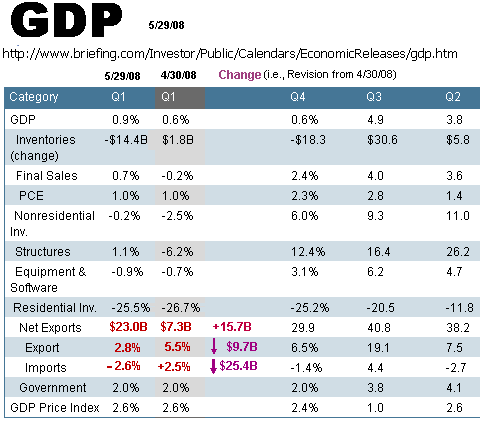
Today's 1st quarter GDP report showed an "increase" in 1st quarter GDP of +0.9%. This was an upward revision of the previous +0.6% estimate from 4/30/08. The upward revision added +$8.8 billion to the earlier estimate.

However, this upward revision was almost entirely the result of a reduction in US purchase of imports. Since imports subtract from GDP, the downward revision of $25.4 billion actually adds +$25.4 billion to GDP growth. To put it another way, the fact that Americans purchases "decreased" resulted in an "increase" in economic growth. This is a typical of the manipulations the government uses to overstate economic growth.

Not only is this a typical distortion of the economy, even the explanation of the reason for the "increase" is deceiving. A perfect example of this deceptive language is provided by Briefing.com, in the following statement:

"The revised rate of 0.9% for Q1 GDP was due to an upward revision to net exports...."
Though the statement is technically true, it is deliberately deceptive. Net imports are the difference between exports and imports, or

Exports - Imports = Net Exports

In fact, actual exports [b]declined[/b] by -$9.7 billion. However, since there was an even larger -$25.4 billion decline in imports, it resulted in
an "upward revision to net exports".

-$9.7 billion - (-$25.4 billion) = +$15.7 billion

Since most Americans are struggling financially, their purchase of imports has declined significantly. These changes are shown in the graphic below from a copy of Briefing.com's GDP report, showing both the current numbers and the numbers prior to revision (labeled 4/30/08).

The numbers for Net Exports (or trade balance), total Exports, and total imports are in red. The changes from the upward revisions are shown in purple with purple arrows showing the direction of change.


The official numbers for 1st quarter GDP from the BEA can be found for the "advanced" report on page 7, Table 3 from 4/30/08 and on page 8, Table 3 for today's "preliminary" report (5/29/08).

Any claims being made by the Financial media that exports are increasing are false. Exports declined -$9.7 billion. The trade deficit improved only because of the huge decline in imports. Again, the import decline is almost the entire reason for the upward revision of 1st Q GDP from 0.6% (from 4/30/08) to 0.9% (on 5/29/08). Another factor contributing to the change is the +$4.7 billion revision of FOOD purchases by Americans, from the previous -$1.6 billion decline up to a +$3.1 billion increase. Thus, the combined addition of decreased import purchases and increased food purchases added a whopping +$30 billion to our 1st quarter GDP. Despite these revisions, the overall upward revision was only +$9.6 billion.

The reason the "increase" was no larger is because nearly every other area declined. Motor vehicle sales fell by -$2.5 billion. Personal Consumption Expenditures were changed less than a fraction of a %. The major reason our GDP "increased" is because our purchase of imports "decreased." Another concocted case of economic "growth" while the economic status of most Americans worsens.

Economic Populist Forum

Sunday, March 23, 2008

Market Ticker: Articles of Impeachment? Bear Stearns Buyout Illegal?

Market Ticker: Articles of Impeachment? Bear Stearns Buyout Illegal?

Tuesday, March 04, 2008

Democrat Taylor Marsh Broadcasts Live Talk Radio and Blogs Politics

Democrat Taylor Marsh Broadcasts Live Talk Radio and Blogs Politics

Sunday, February 17, 2008

Take it to the Polls: Ten Reasons Why I Do Not Support Barack Obama for President

Take it to the Polls: Ten Reasons Why I Do Not Support Barack Obama for President

Wednesday, January 09, 2008

GBPUSD=X: Basic Chart for GBP to USD - Yahoo! Finance

GBPUSD=X: Basic Chart for GBP to USD - Yahoo! Finance

Sunday, September 02, 2007

AAA to CCC and Other Rating Agency Horror Stories

AAA to CCC and Other Rating Agency Horror Stories

Tuesday, August 07, 2007

REPUBLICAN DEBATE POLL RESULTS

(from 8/7/07)


Below is a copy of the latest poll results for the 8/5/07 Republican debate. (Updated 8/7/07)


It looks like Ron Paul by a landslide. A huge one, in fact. Just like every other post-debate poll.

36,893 for Paul, vs.

--4,501 for Romney, vs.
--3,194 for Ghouliani, vs.
--2,659 for Huckabee, vs.
--1,044 for Brownback, vs.
---758 for Tancredo, vs.
---755 for Tommy Thompson, vs.
---731 for McCain, vs.
---421 for Duncan Hunter

Total votes 57,233.


Below is a link to the poll results from the previous Republican debate.
Poll Results

Below is a copy of the previous post-debate results


Ron Paul is winning them all, despite being shunned by the Corporate media plutocracy.

I guess they're afraid that a President Ron Paul would break up their monopolies and reduce their profits.

Monday, August 06, 2007

Behind the Times (subscription wall): Mortgage Mania Didn’t Grip Everyone

Behind the Times (subscription wall): Mortgage Mania Didn’t Grip Everyone

Sunday, July 29, 2007

GDP Declined in 2nd Quarter, prior to manipulation.


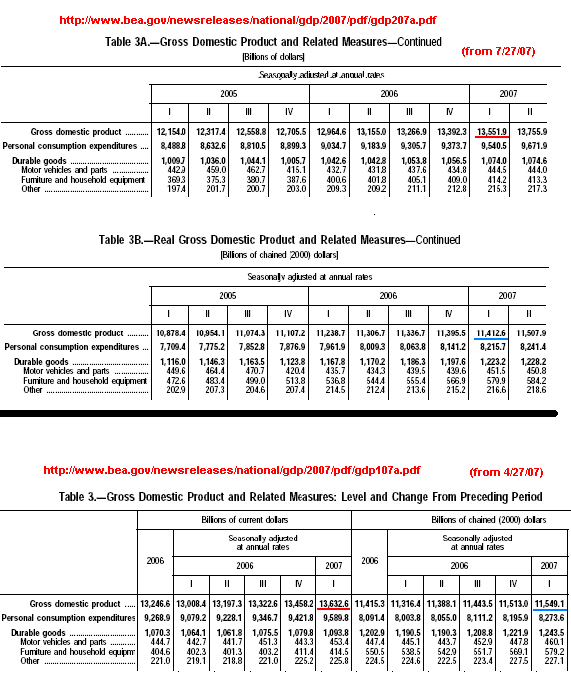
2nd quarter 2007 GDP was actually less than originally posted GDP for the 1st quarter of 2007. (i.e., 2nd quarter GDP growth was negative). Once again, however, the BEA (Bureau of Economic Analysis) manipulated the numbers enough to arrive at a positive 2nd quarter GDP growth. The originally published 1st quarter GDP was downwardly revised by a whopping $137 billion, from the original $11,549 billion down to $11,412 billion.


Again, real GDP growth would have declined for the 2nd quarter, had 1st quarter GDP not been downwardly revised. On the 4/27/07 1st quarter GDP report, the annualized GDP was published as $11,549 billion (in chained 2000 dollars).

On 7/27/07, the GDP report put 2nd quarter annualized GDP $41 billion less than the 1st quarter, at only $11,507.9 billion. This would have made 2nd quarter GDP growth -0.355%. Below is a composite chart from the BEA showing the GDP comparisons. The top 2 charts are from the latest report on 7/27/07. The bottom chart is from 4/27/07. The real GDPs for the 1st quarter are underlined in blue (chained 2000 dollars). The current dollar GDPs for the 1st quarter are underlined in red.


Once again, an after-the-fact revision in previously published numbers has been used to falsely 'create' economic growth.

In this case, it seems pretty clear that 2nd quarter GDP growth should have been negative, and that we are now experiencing recessionary GDP declines.


ADDENDUM:

Also worth noting is that July 27th's GDP was not only lower than the originally posted GDP for the 1st quarter of 2007, it was also less than the previously posted GDP for the 4th quarter of 2006. Thus the cumulative real GDP growth for the 2 quarters ending with the 2nd quarter of 2007 would have been negative, had 4th quarter 2006 and 1st quarter 2007 not been revised downward.

Thus this averages out to 2 consecutive quarters of negative GDP growth-- the textbook definition of a recession.

Economic Populist Forum

Monday, June 25, 2007

INFLATION CONFABULATION


Once again, the Right-Wing Corporate media, along with the Federal government, have confabulated a low inflation rate. Once again, they've selectively focused on only 1 number, the "core" CPI, while ignoring the overall monthly CPI increase of +0.7%. (which, if annualized, comes out to a yearly rate of increase of +8.4%.)
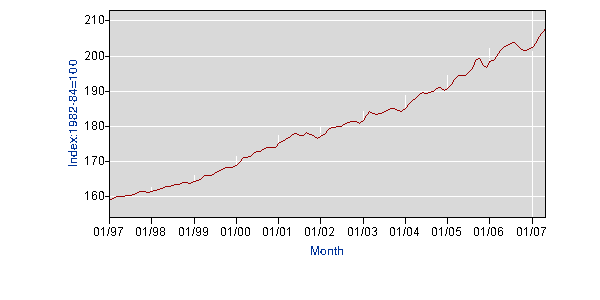
In fact, the overall Consumer Price Index has increased 3.05% in the 1st 5 months of 2007 alone. The annualized increase during the 1st 5 months of 2007 is +7.4%. The "tame" inflation rate during the last 1/2 of 2006 has been replaced by a rapid rise in 2007.
No doubt some will claim that inflation rises faster during the 1st 5 months of the year. However, the 3.05% rise in inflation during the 1st 5 months of 2007 is faster than during any previous year under Bush. The 1st 5 months of 2006 were the closest, with an increase of +2.9%. However, the January through May increase was only +2.1% in 2005, +2.6% in 2004, +1.44% in 2003, +1.75% in 2002, and +2.1% in 2001.

Below is a graph of the CPI from the Bureau of Labor Statistics. Note the rapid acceleration in recent months.


Inflation is clearly rising faster in 2007 than it has during any other time since 2001. The assessment that inflation is "under control" is not just "spin." It is factually wrong.

Economic Populist Forum

Thursday, May 31, 2007

naked capitalism: Foreclosure Stats: Pick a Number, Any Number

naked capitalism: Foreclosure Stats: Pick a Number, Any Number

Sunday, April 08, 2007


Bush's Brown-Shirts: BLACKWATER


Private contractors have now become one of the biggest threats to American liberty and the rule of law. Private contractors, who are accountable to no one, are essentially Bush's own Brown Shirts. Their shear number makes them of great concern.

Blackwater is the biggest "private contractor" provider of mercenaries in Iraq. According to one source, the Washington Post estimates there are 100,000 private contractors in Iraq. Estimates of how much they are paid vary, from $700/day to $100,000 per year. These numbers would mean a cost to American taxpayers of $10-25 billion/year (or more). Numerous articles have been written on the subject.

Blackwater boasts that it provides "elite" forces for hire. As most have heard, these private soldiers are not subject to normal military laws and regulations, nor to any sovereign nation's laws. Unlike normal U.S. citizens, it is apparently legal for Blackwater to purchase and own automatic weapons. There are now several accounts of these private soldiers being deployed within the United States, the most notable case being in New Orleans following Katrina. Below is a link to an archived post on Democratic Underground by poster Carbondate titled America's Private Army.

Other links to information on Blackwater (and other contractors) can be found at:

Inside America's Private Army


Warriors for Hire

---------------


Economic Populist Forum

Labels: ,

Wednesday, April 04, 2007


Has the Recession Arrived?


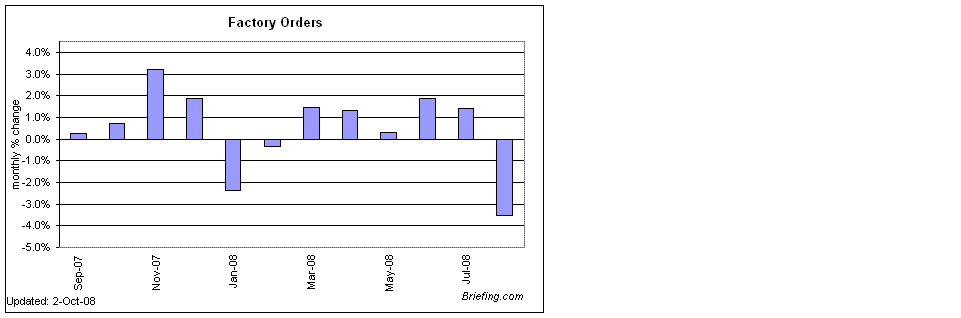
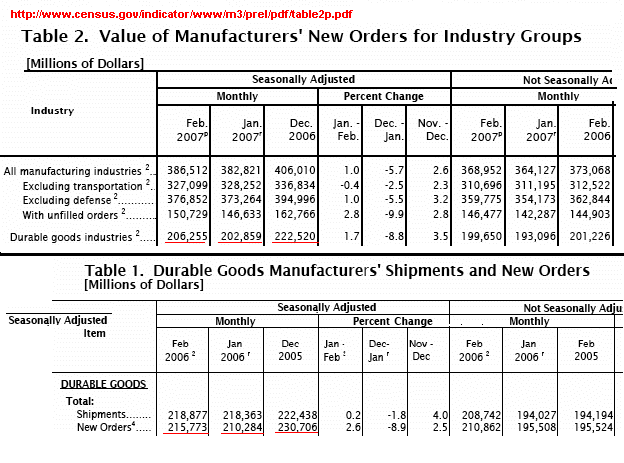
Monthly Factory Orders increased only 1% for the month of February, much less than the +1.8% increase predicted. This follows January's decline of -5.7%. Over the last year, however, Factory Orders are down -1.1%. Ex-transportation orders for February declined -0.4%, following January's -2.5%. This was the 6th month out of the last 7 that ex-transportation orders have declined. February's total factory orders of $386 billion marks a 5% decline since December's seasonally-adjusted $406 billion.

Even some of the previously bullish experts are expressing newly found "concerns." Today's Factory Order report from Briefing.com states "The downward trend in factory orders is tuning in to a real economic concern. The struggling auto and housing sectors add to the softening in business capital investment as business confidence is fading with weak economic growth." They've also expressed a new concern for declining demand, as evidenced by their bolded statement "lack of demand is the heart of the manufacturing concern....." (At long last, some of the market experts are acknowledging that someone has to buy goods if they are going to be produced, and that unpurchased goods don't help the economy. Hallelujah!)

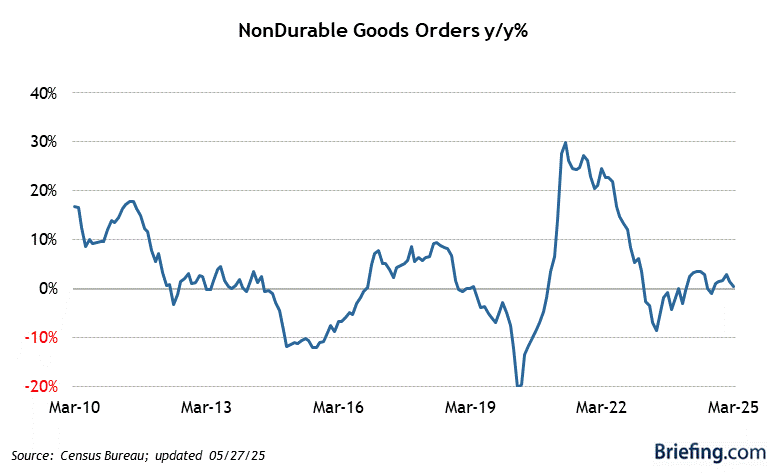
Despite this month's small increase in Factory Orders, the long term trend is clearly downward. This can be seen from the 3 graphs below from Briefing.com.


The Durable Orders decline has been even worse than overall Factory Orders decline. The recently reported Durable Goods Orders increase for February was revised from March 28th's previously stated 2.5% down to a 1.7% increase on April 4th. Comparing the last 3 months total (December, January, & February) for Durable Orders with the same 3 months from the previous year, Durable Goods Orders are down 4.7%, from a 3-month total of $663 billion to $631 billion. This can be seen from the combined, modified charts below from the Census Bureau's April 2007's Factory Orders report and March 2006's Durable Goods report. (April 2007's report is on the top, March 2006 is on the bottom. Durable Goods Orders are underlined in red.)


The American manufacturing sector is clearly in recession. Combined with rapidly declining housing sector, with a subprime meltdown that is metastasizing to other financial sectors, it's difficult to see how this can be called a "strong" economy. It is even more difficult to see how the overall economy won't drift into a recession (if it's not in one already.)

Friday, December 22, 2006


RECESSION LIKELY


12/1/06

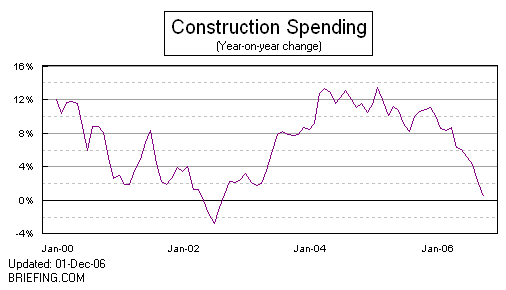
Today's Construction Spending and Manufacturing reports provided still further evidence of a sinking economy. The 2 graphs below from Briefing.com show the overall trend.
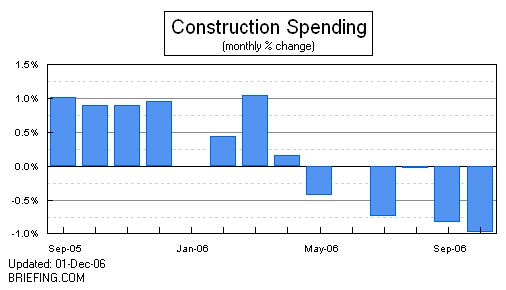

Construction Spending declined 1%, leaving an annualized, seasonally-adjusted rate of $1.16 trillion. This was the largest decline since the recession in 2001. Residential Construction fell 1.9% in the last month. Residential Construction spending has also fallen for 7 consecutive months.


Since March, 100,000 housing-related jobs have been lost. Economist Zoltan Pozsar from Moody's Economy.com, in today's Yahoo News estimates that 300,000 more housing-related jobs will be lost in the next year.


Manufacturing also declined in today's report. This is the first contraction in the Manufacturing sector in almost 4 years. Manufacturing employment also declined in November, with the ISM Manufacturing employment index declining to 49.2 in November from 50.8 in October. (Readings under 50 indicate a contraction.)


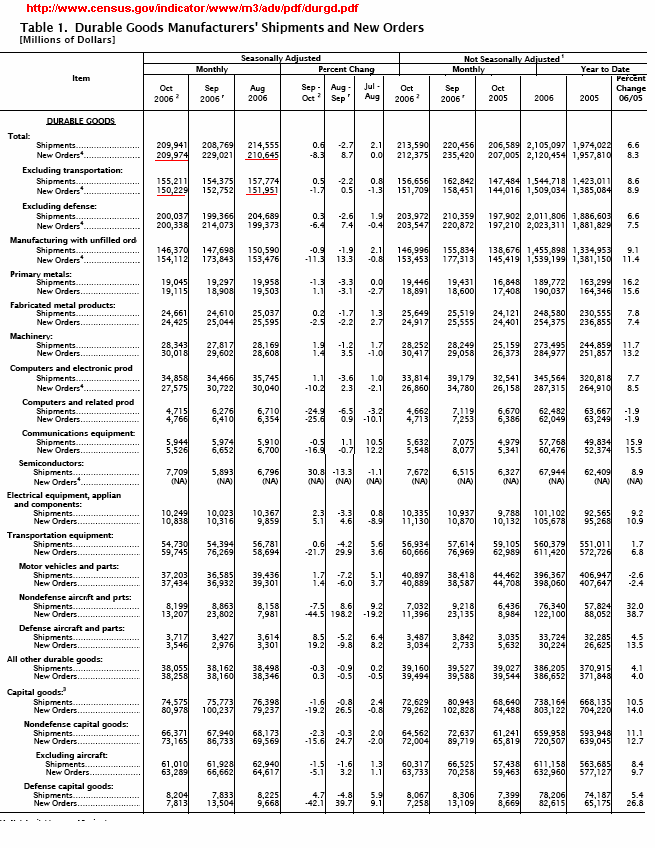
The dollar has dropped 3% in relation to the Euro in the last week, and 1.4% since Thursday morning (11/30/06). The stock market has declined for the 2nd straight week. All of this follows November 28th's Durable Goods, which was much larger than predicted. The original Durable Goods orders prediction was for a decline of only 6.0%. The actual change was a -8.3%. Though much of this was simply an offset from last months increase "alleged" 8.7% increase, October's total is still 0.3% less than August's, and 0.38% less than July's. The August through October numbers can be seen on the chart below from the U.S. Census Bureau. The Durable Orders totals are underlined in red, as are the "Excluding Transportation" totals.

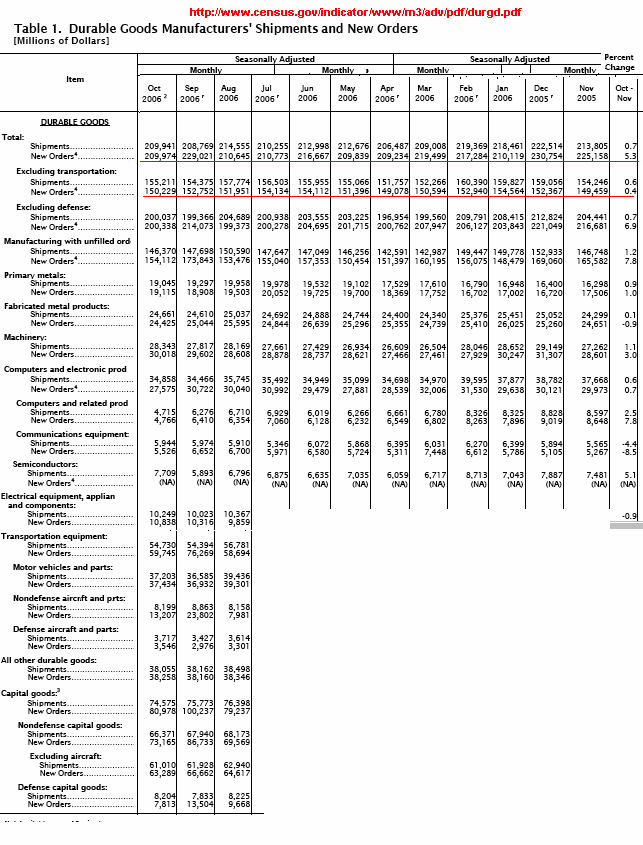
More importantly, Durable Goods orders have declined compared to October 2005, for a same month change of -1.8%. This can be seen from the composite chart below, made from the superimposition of monthly Durable Orders reports from the previous months, with information on the furthest month back coming from the January 2006 report by the Census Bureau. (October 2005's total was not available, so it was extrapolated from the percentage increase given between October - November 2005 change, shown in the far right column.) Once again, the Total and Ex-Transportation numbers are underlined in red. From the above chart it appears Durable Orders peaked In December 2005, and have been generally declining since that time. Compared to December 2005's peak of $230.754 billion, October of 2006 is down 9% to $209.974 billion.

Meanwhile, the Corporatists and the NeoCon-Artists continue to claim the economy is "the strongest ever" and claim the statistics support them. Of course, they never give those "supporting" statistics. There's a reason for that. There aren't any. The economy is sinking and a recession is very likely within the next year. All the Right-Wing propaganda in the world isn't going to change this.


12-19-06 update

Below is copy of an analysis and prediction of the upcoming recession in 2007. It comes from an article by economist Dean Baker from CEPR. Note that Baker predicts a year-over-year GDP growth of -0.7%, a job loss of 1.2 million, and an unemployment rate of 6.3% by 4th quarter of 2007.


unlawflcombatnt


Economic Populist Forum


The economy needs balance between the "means of production" & "means of consumption."

Saturday, December 16, 2006

ECONOMY: FED MANIPULATING STATISTICS (AGAIN)


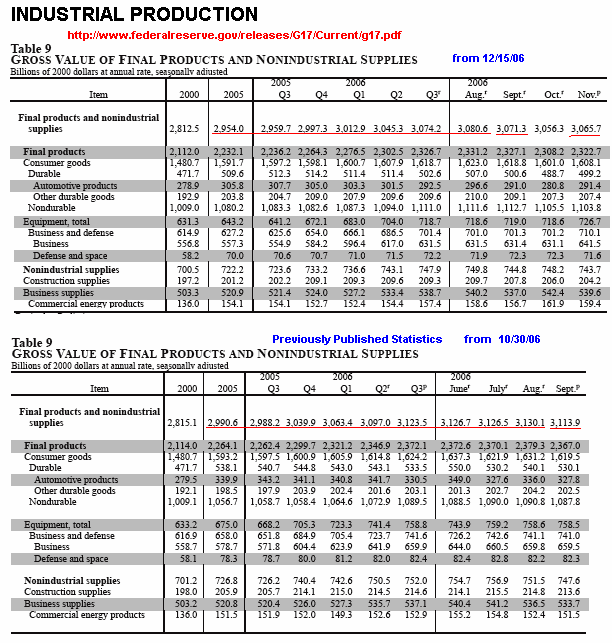
Today's Industrial Production "increase" of 0.2% is another example of the Federal Reserve manipulating statistics to make currently published figures appear "good" or "improved." From the Fed's own publication of Industrial Production figures taken from 10/30/06, the "Gross Value of Final Products and Nonindustrial Supplies" has been downwardly revised for every single time period shown. Every quarterly report has been revised downward. August and September's numbers have been downwardly revised. Even the total for 2005 has been downwardly revised by $36 billion, from the previously reported $2.990 trillion down to $2.954 trillion. (This would subtract approximately 0.1% from 2005's reported GDP.)


Even using only the current numbers, there has been a $15 billion net declinein Industrial Production since August. However, using the previously published number for August of $3.1301 trillion, there has been a decline of $64.4 billion to November's $3.0657 trillion. This is a decline in the annual rate of over 2% in 3 months. (Below is a modified copy of both the Federal Reserves report from 12/15/06 on Industrial Production on the top with a copy of the Fed's report from 10-30-06 on the bottom. The changed numbers are underlined in red.)


(Today's Fed Release can be found at Industrial Production


Are these signs of an economy that is "strong, and getting stronger"? At best, much of this so-called "growth" has been a result of statistical manipulation, especially through the downward revision of previously published numbers.


unlawflcombatnt


Economic Populist Forum


The economy needs balance between the "means of production" & "means of consumption."

Wednesday, December 13, 2006

OUTSOURCING BONANZA: VIETNAMESE TRADE NORMALIZATION


On Friday, December 8th, the House of Representatives passed H.R. 6406, by a vote of 212-184This bill allows for "normalization" of trade with Vietnam.


This new "permanent normalization of trade relations" (PNTR) with Vietnam is the first step in opening up their labor market to exploitation by Corporate America and to the outsourcing of American jobs to Vietnam.


What are the relative "benefits" to the United States? It allegedly opens up the Vietnamese "consumer" market to American goods. However, the benefit of such market opening is minuscule. The exchange traded value of Vietnam's entire GDP is only $43 billion. (See Vietnam: CIA assessment ) This is approximately 3/100ths of a percent of U.S. GDP. To put it another way, if Vietnam's entire GDP was spent on American imports, it would raise U.S. GDP .03%. So a U.S. GDP growth of 2.20% would rise to 2.23%. Again, this is assuming ALL of Vietnam's GDP was spent on American goods, which is certainly not going to happen. Vietnam's Exchange Rate per capita GDP is only $521/year. {Vietnam's Purchasing Power Parity (PPP) per capita GDP is listed as $2800. By converting this to an exchange rate value this becomes a per capita income of only $521/year. It's the Exchange Rate income that is important here, because this measures the ability to purchase American imports.} Given these numbers it's very unlikely that we can sell significant U.S production to Vietnamese consumers.


What's the downside? Vietnam has a labor force of 43 million workers. Once Vietnam is opened up to investment by Corporate America, this could become a virtual addition of 43 million workers to America's 152 million participating labor force. If Corporate America replaced 43 million American workers ( averaging $17/hour ) with 43 million Vietnamese workers, it would reduce American labor & consumer income by $1.52 trillion.


(43 million X $17/hr. X 8 hrs./day X 365 days/yr. X 5 days/wk divided by 7 days/week = $1.52 trillion. )


This would also reduce American consumer spending power by $1.52 trillion dollars. A decline in consumer spending by that $1.52 trillion, subtracted directly from our $13 trillion GDP, would amount to a direct decline in our GDP of almost 12%. (Applying any multiplier would drop our GDP far more than 12%) Of course, we could "gain" that whopping 0.03% in GDP from selling our exports to Vietnam.


These are theoretical calculations only, designed to show the magnitude of relative benefits vs. costs to Americans from "normalization" of trade with Vietnam. While Corporate America is not likely to hire all 43 million Vietnamese workers, it's clear that the potential loss to our economy is much greater than the potential gain. We'll gain an almost non-existent consumer market from Vietnam, while adding a virtual 43 million workers to America's labor pool. And the direct loss of jobs is only the measurable effect. The decline in American wages from the supply & demand effect of competition with another 43 million impoverished workers hasn't been calculated. Clearly this would decrease American wages and labor income MUCH more than just $1.52 trillion.


To the majority of Americans, permanent normalization of trade with Vietnam is exclusively negative. Once again, it'll put American workers (and their wages) in direct competition with impoverished 3rd world workers. Clearly the goal here is not to open up the Vietnamese consumer market to American goods. The goal is to open up the Vietnamese labor market to American Multinational Corporations. The true goal is to replace even more American workers with easily exploitable semi-slave laborers of another impoverished country. It'll be another disaster for American workers, and another windfall profit gain for rich Globalist Corporations.


unlawflcombatnt


Economic Populist Forum

Sunday, November 05, 2006


9/11 - SADDAM & bin LADEN
NO CONNECTION - as per Senate Report


Below is an article from Mercury News describing the Senate's latest report about Saddam's alleged connection with bin Laden and Al Qaida. Though the information is not exactly new, it now has an official stamp of "truthfulness" by the Senate.

The Bush Myth-ocracy was completely, and absolutely wrong about any connection between Saddam Hussein and either bin Laden or Al Qaida. Whether the Bush-ites lied, or were honestly misinformed can be debated. But the wrongness of their assertions is cannot. Congress and the American people were completely misinformed about such connection by the Bush administration. Period.

http://www.mercurynews.com/mld/mercurynews/news/world/15474492.htm

"Posted on Fri, Sep. 08, 2006 Senate reports say Saddam rejected cooperating with terrorists

By Warren P. Strobel and Margaret TalevMcClatchy Newspapers
WASHINGTON - Iraqi leader Saddam Hussein rejected pleas for assistance from Osama bin Laden and tried to capture terrorist Abu Musab al Zarqawi when he was in Iraq, a Senate Intelligence Committee report released Friday found, casting further doubt on the Bush administration's rationale for invading Iraq.


President Bush and other administration officials repeatedly cited Saddam's alleged ties to radical Islamic terrorists before the March 2003 invasion as one reason to take military action against Iraq.

The 150-page report said the administration's claims were untrue. "Postwar findings indicate that Saddam Hussein was distrustful of al-Qaida and viewed Islamic extremists as a threat to his regime, refusing all requests from al-Qaida to provide material or operational support," the report said.

The report was released along with a second one that said false information from the exile group Iraqi National Congress, led by Ahmad Chalabi, was widely distributed in prewar intelligence reports and used to support intelligence assessments about Iraq's weapons and links to terrorism. Intelligence officials repeatedly warned that the INC was unreliable, but White House and Pentagon officials ignored the warnings.

The reports are part of a five-report study that the Senate Intelligence Committee has undertaken into the Bush administration's use of intelligence before the invasion of Iraq.
The study has left the committee badly divided. Three reports remain classified, including one comparing prewar statements by Bush administration officials to intelligence available at the time. Democrats have accused Republicans of delaying the reports until after the November congressional elections.

On Friday, Democrats charged that the reports showed that the White House had manipulated intelligence to make the case for war to the American people.

"The administration ignored warnings prior to the war about the veracity of the intelligence it trumpeted publicly to support its case that Iraq was an imminent threat to the security of the United States," said panel Vice Chairman Sen. Jay Rockefeller, D-W.Va.

Republicans rejected that allegation and said the reports added little to what was already known.

"The long-known fact is that the prewar intelligence was wrong. That flawed intelligence was used by policymakers, both in the administration and in Congress, as one of numerous justifications to go to war in Iraq," said committee chairman Sen. Pat Roberts, R-Kan.

In the run-up to the war, Bush and his advisers repeatedly sought to link Saddam and al-Qaida, stopping just short of accusing the Iraqi leader of a role in the Sept. 11, 2001, terrorist attacks.

"You can't distinguish between al-Qaida and Saddam when you talk about the war on terror," Bush said on Sept. 25, 2002.

On the same day, Condoleezza Rice, then the White House national security adviser, said, "High-ranking detainees have said that Iraq provided some training to al-Qaida in chemical weapons development." The detainee Rice referred to was al-Qaida operative Ibn al Shaykh al Libi, who was captured in Pakistan in November 2001 and, U.S. intelligence officials said, tortured by Egyptian authorities after his transfer to that country.

The Senate report says that in February 2002, months before Rice spoke, the Defense Intelligence Agency reported that al Libi "was likely intentionally misleading his briefers."
Postwar information on Saddam's relations with Islamic extremists came from numerous sources, the report suggests, including seized documents and interrogations of Saddam himself, former Deputy Prime Minister Tariq Aziz and a senior Iraqi spy, Faruq Hijazi.

The report, quoting from an FBI debriefing of Hijazi, said that when an Iraqi operative met bin Laden in Sudan in 1995, bin Laden asked that Saddam allow him to open an office in Iraq, give him Chinese-made sea mines and military training, and broadcast his speeches.

"According to Hijazi, Saddam immediately refused," the FBI debriefing said.
Regarding Zarqawi, the Senate report cites information that's surfaced since the war indicating that Saddam "attempted, unsuccessfully, to locate and capture" him and the Iraqi regime "did not have a relationship with, harbor, or turn a blind eye toward Zarqawi."

Zarqawi, who operated from a part of northern Iraq that Saddam didn't control, was a key part of Bush's case for war. After the invasion, he became the head of the group al Qaida in Iraq. U.S. bombs killed him in June.

The second report released Friday confirms that the INC had "an aggressive `publicity campaign' prior to the war to bring defectors to the attention of `anyone who would listen.'"
While many committee Republicans dismissed the INC report's conclusions as unsupported by the facts, two of them, Sens. Olympia Snowe of Maine and Chuck Hagel of Nebraska, voted for harsher language that Democrats proposed.

The report, which ran 211 pages, disclosed that three months after the White House approved continued funding for the INC's intelligence collection in July 2002, the Defense Intelligence Agency warned that the group "was penetrated by hostile intelligence services," including Iran's. It's unclear whether top White House officials were aware of the warning.

The report also confirms a report by McClatchy Newspapers that former CIA director R. James Woolsey helped get an INC defector attention from the U.S. government by referring him to Deputy Assistant Secretary of Defense Linton Wells.

The defector, Adnan Ihsan Saeed al Haideri, suggested that he had knowledge of dozens of sites related to weapons of mass destruction, but none of them were ever found, and Haideri, taken to Iraq in early 2004, couldn't identify the facilities that he claimed he knew about.
McClatchy Newspapers correspondents Matt Stearns and John Walcott contributed to this article.

© 2006 McClatchy Washington Bureau and wire service sources. All Rights Reserved.

http://www.mercurynews.com


EconomicPopulistForum

ECONOMY UPDATES


ECONOMIC ARMAGEDDON ?


Faith-based economy or
Fate-based Armageddon?


Several well-known economists believe the US will likely experience a sharp economic downturn in the near future. Among these economists are Steven Roach of Morgan Stanley and Paul Krugman of MIT. Add to this list economist Joseph Stiglitz, Nobel prize winner and Columbia University economics professor. Stiglitz describes our situation in his January 1, 2005 article from the Guardian - "This can't go on forever - so it won't." The link is http://www.guardian.co.uk/print/0,3858,5094396-108079,00.html

Several economists believe the cause of the Great Depression in the 1930's was a demand-side failure. Among them again, is MIT economist, Paul Krugman, who also writes for the New York Times. In 1999, Krugman wrote the book Return of Depression Economics. In this book he describes how 8 modern world economies suffered severe declines, most during a period of less than 3 years. Krugman believes these were due mainly to demand-side failure (i.e., due to insufficient consumer spending.) Among the victims were Japan and Korea. Krugman describes their inability to change course until it was too late. Krugman also notes the drift of U.S. economic policy away from the demand side toward the supply side over the last 2 decades. The same shift preceded the Great Depression of the 1930's. Are we heading there again?

Krugman may well be able to predict the future. He's done so in the past. His books reveal an uncanny ability to predict future economic events. Krugman suggested in 1999 that an economic downturn, like those experienced by other world economies, could happen here. In 2001, it did happen here.

Krugman recently suggested that a recurrence of another economic downturn is not a question of "if," it's a question of "when." He was right before. Will he be right again? With a president unable to change course, in spite of obvious policy failures, the chances of Krugman's predictions coming true are even greater. In my opinion, they're almost guaranteed. An economic Armageddon seems more likely by the day.

_____________________


BUSH Job Approval Rating

Image hosted by Photobucket.com

Here's a link to the above poll from MSNBC:
http://www.msnbc.msn.com/id/10562904#survey


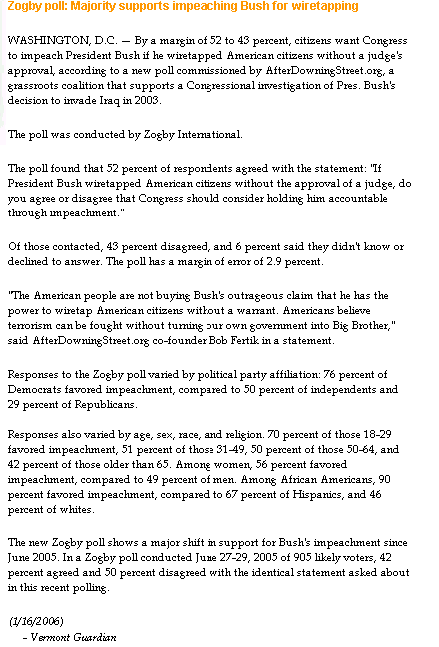
In a the most recent January 2006 Zogby poll, 52% thought Bush should be impeached. Below is a copy of the Zogby poll commentary.

Image hosting by Photobucket


BUSH JOB APPROVAL RATING (Standard "Scientific" Polls)


9/24/06 - - - -- 42% Approve - - - - - - - 55% Disapprove
from CNN
http://www.pollingreport.com/BushJob.htm

9/19/06 - - - -- 45% Approve - - - - - - - 52% Disapprove
from L.A. Times/Bloomberg
http://www.pollingreport.com/BushJob.htm

9/19/06 - - - -- 37% Approve - - - - - - - 56% Disapprove
from CBS/New York Times
http://www.pollingreport.com/BushJob.htm

9/13/06 - - - -- 39% Approve - - - - - - - 60% Disapprove
from AP-Ipsos
http://www.pollingreport.com/BushJob.htm

9/11/06 - - - -- 42% Approve - - - - - - - 53% Disapprove
from NBC/Wall Street Journal
http://www.pollingreport.com/BushJob.htm

9/10/06 - - - -- 37% Approve - - - - - - - 53% Disapprove
from Pew
http://www.pollingreport.com/BushJob.htm

8/25/06 - - - -- 36% Approve - - - - - - - 56% Disapprove
from Newsweek
http://www.pollingreport.com/BushJob.htm

8/21/06 - - - -- 36% Approve - - - - - - - 57% Disapprove
from CBS/New York Times
http://www.pollingreport.com/BushJob.htm

8/20/06 - - - -- 42% Approve - - - - - - - 57% Disapprove
from CNN
http://www.pollingreport.com/BushJob.htm

8/13/06 - - - -- 36% Approve - - - - - - - 57% Disapprove
from CBS
http://www.pollingreport.com/BushJob.htm

8/13/06 - - - -- 37% Approve - - - - - - - 54% Disapprove
from Pew
http://www.pollingreport.com/BushJob.htm

8/06/06 - - - -- 40% Approve - - - - - - - 58% Disapprove
from ABC/Washington Post
http://www.pollingreport.com/BushJob.htm

8/03/06 - - - -- 40% Approve - - - - - - - 59% Disapprove
from CNN poll
http://www.pollingreport.com/BushJob.htm

8/01/06 - - - -- 40% Approve - - - - - - - 58% Disapprove
from LA Times/Bloomberg poll
http://www.pollingreport.com/BushJob.htm

7/25/06 - - - -- 36% Approve - - - - - - - 55% Disapprove
from CBS/New York Times poll
http://www.pollingreport.com/BushJob.htm

7/24/06 - - - -- 39% Approve - - - - - - - 56% Disapprove
from AP-Ipsos poll
http://www.pollingreport.com/BushJob.htm

7/12/06 - - - -- 36% Approve - - - - - - - 63% Disapprove
from NBC/Wall Street Journal poll
http://www.pollingreport.com/BushJob.htm

6/29/06 - - - - 35% Approve - - - - - - - 59% Disapprove
from Time magazine poll
http://www.pollingreport.com/BushJob.htm

6/27/06 - - - - 41% Approve - - - - - - - 50% Disapprove
from L.A. Times/Bloomberg poll
http://www.pollingreport.com/BushJob.htm

6/25/06 - - - - 37% Approve - - - - - - - 60% Disapprove
from USA Today/Gallop poll
http://www.pollingreport.com/BushJob.htm


6/25/06 - - - - 38% Approve - - - - - - - 60% Disapprove
from ABC/Washington Post poll
http://www.pollingreport.com/BushJob.htm

6/19/06 - - - - 36% Approve - - - - - - - 54% Disapprove
from Pew poll
http://www.pollingreport.com/BushJob.htm

6/15/06 - - - - 37% Approve - - - - - - - 53% Disapprove
from CNN poll
http://www.pollingreport.com/BushJob.htm

6/12/06 - - - - 37% Approve - - - - - - - 58% Disapprove
from NBC/Wall Street Journal
http://www.pollingreport.com/BushJob.htm

6/11/06 - - - - 33% Approve - - - - - - - 60% Disapprove
from CBS poll
http://www.pollingreport.com/BushJob.htm

6/11/06 - - - - 37% Approve - - - - - - - 58% Disapprove
from USA Today/Gallop
http://www.pollingreport.com/BushJob.htm

6/07/06 - - - - 35% Approve - - - - - - - 63% Disapprove
from AP-Ipsos poll
http://www.pollingreport.com/BushJob.htm

6/04/06 - - - - 36% Approve - - - - - - - 57% Disapprove
from USA Today/Gallop poll
http://www.pollingreport.com/BushJob.htm

5/30/06 - - - - 35% Approve - - - - - - - 58% Disapprove
from Quinnipiac poll
http://www.pollingreport.com/BushJob.htm

5/15/06 - - - - 33% Approve - - - - - - - 65% Disapprove
from ABC/Washington Post poll
http://www.pollingreport.com/BushJob.htm

5/12/06 - - - - 35% Approve - - - - - - - 59% Disapprove
from Newsweek poll
http://www.pollingreport.com/BushJob.htm

5/08/06 - - - - 29% Positive -- - - - - - - 71% Negative
from Wall Steet Journal/Harris poll
http://biz.yahoo.com/prnews/060512/nyf066.html?.v=51

5/08/06 - - - - 31% Approve - - - - - - - 63% Disapprove
from CBS/New York Times poll
http://www.pollingreport.com/BushJob.htm

5/07/06 - - - - 34% Approve - - - - - - - 58% Disapprove
from CNN poll
http://www.pollingreport.com/BushJob.htm

5/07/06 - - - - 31% Approve - - - - - - - 65% Disapprove
from USA Today/Gallop poll
http://www.pollingreport.com/BushJob.htm

4/23/06 - - - - 32% Approve - - - - - - - 60% Disapprove
from CNN poll
http://www.pollingreport.com/BushJob.htm

4/16/06 - - - - 35% Approve - - - - - - - 55% Disapprove
from Pew Research poll
http://www.pollingreport.com/BushJob.htm

4/13/06 - - - - 36% Approve - - - - - - - 59% Disapprove
from Gallop poll
http://www.pollingreport.com/BushJob.htm

3/30/06 - - - -37% Approve - - - - - - - -57% Disapprove
from Time poll
http://www.pollingreport.com/BushJob.htm

3/17/06 - - - - 36% Approve - - - - - - - 58% Disapprove
from Newsweek poll
http://www.pollingreport.com/BushJob.htm

3/13/06 - - - - 34% Approve - - - - - - - 57% Disapprove
from NBC/Wall Street Journal poll
http://www.pollingreport.com/BushJob.htm

3/12/06 - - - - 34% Approve - - - - - - - 57% Disapprove
from CBS poll
http://www.pollingreport.com/BushJob.htm

3/12/06 - - - - 33% Approve - - - - - - - 59% Disapprove
from Pew poll
http://www.pollingreport.com/BushJob.htm

3/08/06 - - - - 37% Approve - - - - - - - 60% Disapprove
from AP-Ipsos poll
http://www.pollingreport.com/BushJob.htm

2/26/06 - - - - 34% Approve - - - - - - - 59% Disapprove
from CBS poll
http://www.pollingreport.com/BushJob.htm

2/21/06 - - - - 38% Approve - - - - - - - 58% Disapprove
from American Research Group poll
http://www.pollingreport.com/BushJob.htm

2/12/06 - - - - 39% Approve - - - - - - - 56% Disapprove
from CNN/USA Today/Gallop poll
http://www.pollingreport.com/BushJob.htm

2/08/06 - - - - 40% Approve - - - - - - - 57% Disapprove
from AP-Ipsos poll
http://www.pollingreport.com/BushJob.htm

2/05/06 - - - - 40% Approve - - - - - - - 52% Disapprove
from Pew Research poll
http://www.pollingreport.com/BushJob.htm

1/29/06 - - - - 39% Approve - - - - - - - 54% Disapprove
from NBC-Wall Street Journal poll
http://www.pollingreport.com/BushJob.htm

1/25/06 - - - - 43% Approve - - - - - - - 54% Disapprove
from CBS/New York Times poll
http://www.pollingreport.com/BushJob.htm


for comparison, here are some of President Clinton's last Job Approval Ratings.


Clinton's Job Approval Ratings:
1/15/01 - - 66% Approve - - - - - - - 31% Disapprove
from NBC/Wall Street Journal Poll
http://www.pollingreport.com/clinton-.htm

1/11/01 - - 64% Approve - - - - - - - 33% Disapprove
from CNN/Time Poll
http://www.pollingreport.com/clinton-.htm

12/11/00 - 68% Approve - - - - - - - 28% Disapprove
from, CBS News Poll
http://www.pollingreport.com/clinton-.htm


_______________________


Economy Status: 5/2/05

GDP Changes from Briefing.com
(The blue numbers represent the latest "revisions" as of 11-27-05, as per "Briefing.com.")

....................................2005..........2004.........2004.......2004........2004.......2003
Category.....................Q1............Q4.............Q3..........Q2..........Q1..........Q4
GDP.............................3.8%........3.8%..........4.0..........3.3...........4.5..........4.2
GDP revisions:...........................3.3%.........................................4.2
..Inventories
..(change)...............$80.2B......$45.8B.......$34.5......$61.1......$40.0.......$8.6
..GDP Final Sales.......3.0%........3.4%...........5.0..........2.5..........3.3.........3.7
....PCE..........................3.5%........4.2%...........5.1..........1.6..........4.1.........3.6
......Durables...............0.0%........3.9%..........17.2........-0.3..........2.2.......23.9
......Nondurables .......4.9%........5.9%............4.7..........0.1..........6.7.........5.1
......Services................3.6%........3.4%............3.0..........2.7..........3.3.........2.8
....Nonresidential
....Investment.............4.7%.......14.5%..........13.0.......12.5.........4.2........11.0
......Structures............-2.6%.........2.1%..........-1.1.........6.9........-7.6..........7.9
......Equipmnt
......&Software.............6.9%.......18.4%.........17.5.......14.2.........8.0.......12.0
....Residential Inv.......5.7%.........3.4%............1.6.......16.5.........5.0.........9.6
....Imp/Exp change
....Net Exports.........-$42.0B.....-$37.9B.........-$2.9...-$30.2....-$22.0....-$19.0
......Exports...................7.0%..........3.2%...........6.0.........7.3.........7.3........17.5
......Imports.................14.7%........11.4%...........4.6.......12.6.......10.6........17.1
....Government.............0.6%..........0.9%...........0.7.........2.2.........2.5..........1.6
GDP Price Index..........3.2%..........2.3%...........1.4.........3.2.........2.8..........1.6
After-tax corp
profits...........................na..............na.............-5.3..........1.6-.........1.1........11.2

Information source:
http://www.briefing.com/Silver/Calendars/EconomicReleases/gdp.htm


REAL Unemployment Rate, January 2005: 7.2%

REAL Unemployment Rate, January 2001: 4.2%

The above mentioned unemployment rate manipulation is described further below. Another description of the Bush administration's deliberate underestimation of the unemployment rate can also be found in Scott Lilly's article from the Center for American Progress: http://www.americanprogress.org/site/pp.asp?c=biJRJ8OVF&b=403577&printmode=1
___________________


ECONOMY ASSESSMENT:


Definite slowdown in economic growth from 3rd quarter 2004 to 4th quarter, with GDP growth decreasing from 4.0% to 3.1%. Actual GDP growth is much less than 4.5% prediction from late 2004. It's also much less than the 4.0% predicted by market analysts in mid-January of 2005. Worse still, the GDP change understates the actual change. Final GDP sales growth dropped from 5.0% in 3rd quarter 2004, to 2.7% in the 4th quarter. This indicates a smaller increase in actual product sales from the 3rd to 4th quarters. It also implies increasing surplus production. Increasing inventories and decreasing sales will further reduce labor demand, causing further stagnation of wages and new hiring. Increasing trade deficits and interest rate increases will further reduce domestic product sales, which further exacerbate wage decreases and hiring slowdowns. Large-scale loss of jobs to overseas outsourcing is expected to greatly increase.


The job picture is not encouraging. According to the Dept. of Labor, payroll jobs increased 133,000 in December 2004 (revised downward from the original, deliberately overstated 157,000.) January's 146,000 number is not encouraging. It is much less than initial estimate of 215,000 stated by the administration and market spin doctors. Most analysts state labor force growth is 150,000 per month, which means we need to create 150,000 jobs per month to break even. Thus the job deficit over the last 2 months is 21,000 less than necessary to keep up with labor force growth. This will put further downward pressure on wages.

Economic growth is slowing much faster than financial analysts predicted in late 2004. All evidence suggests this decline will continue unabated. The employment situation appears gloomy. The "real" unemployment rate has increased from 4.2% to 7.2%. The number of private sector jobs is less than it was in January of 2001. The US population has increased 12 million in that time. In spite of market and administration hype, the economy is on the decline. There are no positive trends.

The latest unemployment statistics are deliberate, numerical deceptions. Using the workforce participation rate used in January of 2001, the current unemployment rate is actually 7.2%, not 5.2% as deceptively stated by the Bush administration. More on this deliberate miscalculation below.

_____________________

______________________

UNEMPLOYMENT RATE DISTORTION:

Unemployment is calculated through the unreliable household survey. The unemployment rate % has also been deliberately manipulated by reducing the labor force "participation" rate. By doing this, the real unemployment rate is reduced by 2%. Unemployment numbers are calculated by taking the estimated total labor force number, multiplied by labor force participation rate. The percentage of the total "participating" labor force not employed is the unemployment rate. Obviously, these numbers can be easily manipulated by falsely understating the total number of workers in the labor force. More insidiously, however, they can be altered by falsely reducing the labor force participation rate. This has been done since the beginning of the Bush plutocracy. The actual labor force participation rates can be found at the Dept. of Labor site under labor force participation rates at the following link: http://data.bls.gov/PDQ/servlet/SurveyOutputServlet?data_tool=latest_numbers&series_id=LNS11300000

Below are the labor force participation rate % from the bls site:

Year---Jan---Feb---Mar--Apr--May--Jun---Jul----Aug---Sep-- Oct---Nov--Dec

1998 -67.1 -67.1- 67.1 -67.0 -67.0 -67.0 -67.0 -67.0 -67.2 -67.2 -67.1 -67.2

1999 -67.2 -67.2 -67.0 -67.1 -67.1 -67.1- 67.1- 67.0- 67.0- 67.0- 67.1 -67.1

2000 -67.3 -67.3 -67.3 -67.3 -67.1 -67.1 -66.9 -66.9 -66.9 -66.8 -66.9 -67.0

2001 -67.2 -67.1 -67.2 -66.9 -66.7 -66.7 -66.8 -66.5 -66.8 -66.7 -66.7 -66.7

2002 -66.4 -66.7 -66.6 -66.7 -66.7 -66.6 -66.5 -66.6 -66.7 -66.6 -66.4 -66.3

2003 -66.4 -66.3 -66.2 -66.4 -66.3 -66.5 -66.2 -66.1 -66.1 -66.1 -66.2 -66.0

2004 -66.1 -65.9 -65.9 -65.9 -65.9 -66.0 -66.2 -66.0 -65.9 -66.0 -66.1 -66.0

2005 -65.8 -65.8 -65.8

(Note the difference in participation rate from January 2001 to March 2005)

Here's how the unemployment rate can be altered by the "participation rate." For example, if the total available labor force is 140,000,000, it would be multiplied by the current participation rate of 65.8%. This would give a participating labor force of 92,120,000 workers. A 5.2% unemployment rate means that 87,330,000 are employed, while 4,790,000 are unemployed. If the same total labor force is multiplied by a 67.2% participation rate (the rate used in January, 2001,) the participating labor force is 94,080,000. If the same number are employed as before, 87,330,000, the number of unemployed is 6,750,000. (Again, this is just an example based on an arbitrary labor force of 140,000,000. The actual number of unemployed workers was 8 million at the end of February, 2005.) Based on these numbers, this gives an unemployment rate of 7.2%, instead of 5.2%. So the current unemployment rate would actually be 7.2%, if the 67.2% labor force participation rate of January of 2001 was used. The Bush administration has lowered the unemployment rate by arbitrarily altering the labor force participation rate. They have greatly increased unemployment. In this example, they have simply removed 2 million unemployed workers from the unemployment roles by numerical chicanery. When Bush took office, the unemployment rate was 4.2% (using a 67.2% participation rate.) Unemployment is currently 7.2%, using the same labor force participation rate used in January, 2001.

_____________________________________

_____________________________________________________

WAGES: (as of May 2006)

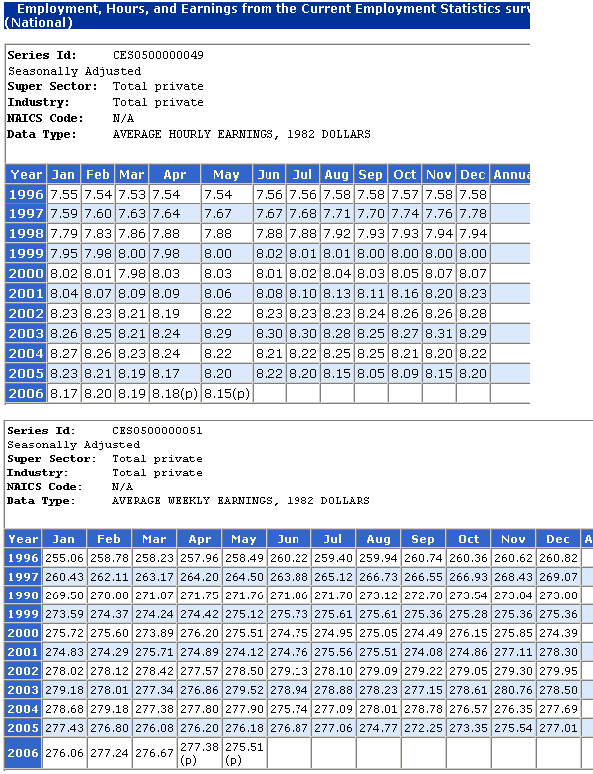
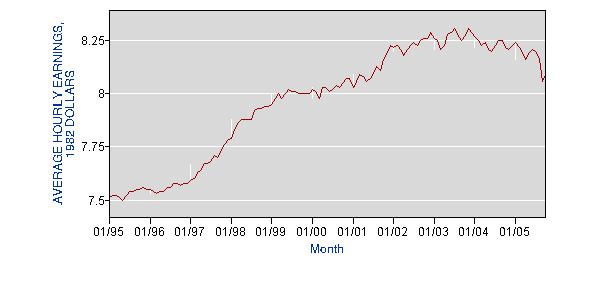
Wages, when adusted for inflation, have decreased over the last 2 years. From November 2003 to through May 2006, "real" hourly wages have decreased 1.9%. Since the end of January 2005 through May 2006, inflation-adjusted hourly wages have decreased 1.0% ( from $8.23/hour in January 2005 to $8.15/hour in May 2006) For the year 2006, real hourly wages have decreased 0.6% as of May 2006. Again, these are inflation-adjusted wages calculated by the Bureau of Labor Statistics. Below is a graph and a chart of wage changes in "real" inflation-adjusted 1982 dollars going through November of 2005Image hosted by Photobucket.com
UPDATE: 4-8-07

Below are hourly and weekly wages thru February 2007:
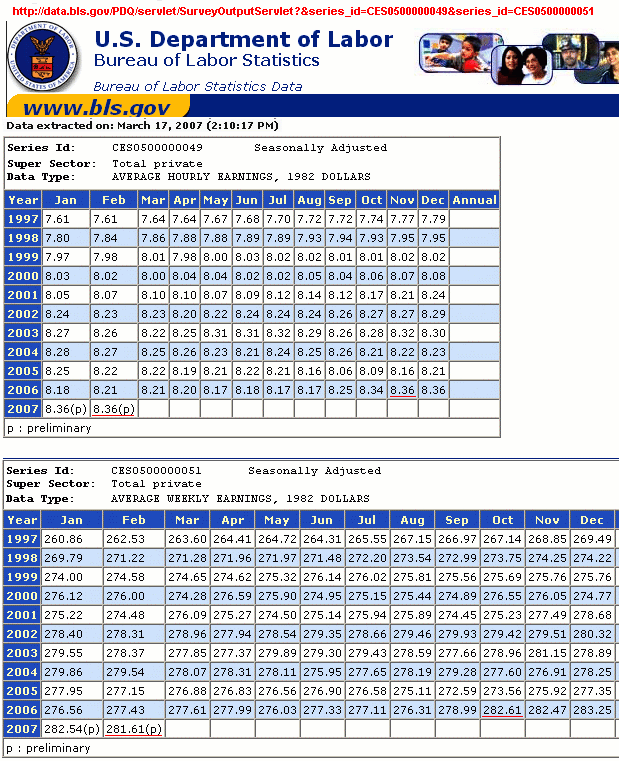


Below are links to the BLS charts of hourly and weekly wage changes:

http://data.bls.gov/PDQ/servlet/SurveyOutputServlet?data_tool=latest_numbers&series_id=CES0500000049

http://data.bls.gov/PDQ/servlet/SurveyOutputServlet?data_tool=latest_numbers&series_id=CES0500000051

_______________________________

12/17/05 Update:

The downward trend in real weekly wages has accelerated over the last 2 years. Since January of 2004, real weekly wages have declined 1.4%. Below is a graph from the United States Bureau of Labor Statistics:
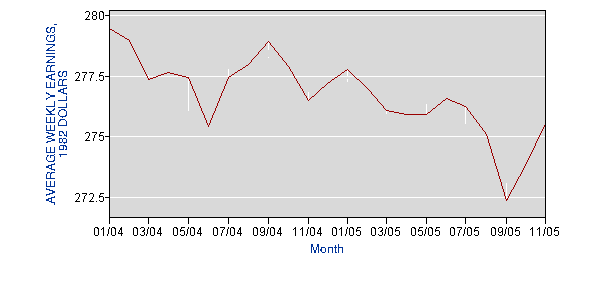
Image hosted by Photobucket.com

Weekly wages are important because they are a better indicator of the amount of wage income consumers have to spend on goods, services, and other expenses.

_________________

_________________

_________________

_________________

RECESSION ALERT!

The Recession Alarm was officiallysounded. It has since been rescinded by altering the initial statistics posted. Another case of "revisionist" history. According to Briefing.com, "The recession alarms go off when the cumulative 6 month decline [in Leading Indicators] exceeds 1.0% amid a string of 3 or more consecutive monthly declines..." "With a 5th consecutive decline and a cumulative 6-month decline exceeding -1.0% the index suggests an economic contraction..." There has actually been a 6 month decline of -1.4%. Note: economic "contraction" = RECESSION. It is of interest to note, however, that Briefing.com initially called this a "false alarm." That's what financial experts always claim, when their own criteria result in a negative finding. (There must be some reason our criteria led to an incorrect conclusion, because we just don't want to accept it. And we don't want the public to accept it, either, because they'll stop spending and investing. Later they simply changed the numbers so that they could claim there never was a recession alarm in the first place. ) It's nice to know our financial "experts" are completely unemcumbered by any sense of truth or honesty. The link for the Leading Indicators is at: http://www.briefing.com/GeneralContent/Active/PrintPage/PrintPage.aspx?PageId=217
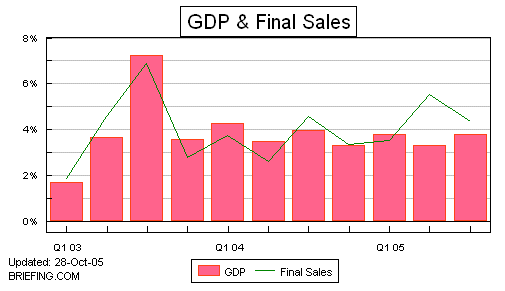
Update: 11/27/05
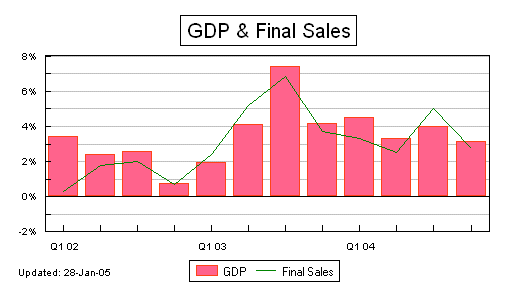
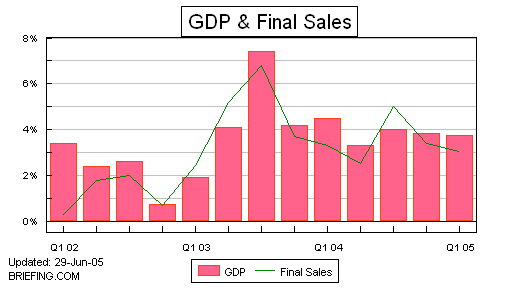
It now appears that the 3rd quarter 2004 GDP has been revised downward to 3.6 % which is what it was initially reported as like it in January of 2005. (By June 2005 it had been upwardly, and incorrectly, revised to 3.8%. Apparently they just "honestly" overestimated in June.)

Below are the graphs of the GDP previously reported, which were posted by "Briefing.com." The 1st is from January 2005, the 2nd is from June 2005, and the 3rd is from 11-27-05. Again, not the difference in the 4th quarter 2004 GDP. It has been revised back down to the previously reported 3.6% number.


1-28-05
Image hosted by Photobucket.com


6-29-05
Image hosted by Photobucket.com


11-27-05
Image hosted by Photobucket.com

Also of interest is that the 4th quarter GDP from 2003 has also been downwardly revised. Up through June of 2005, it had been listed as being over 4%. Now it has also been revised downward to 3.8%.

It's simply amazing how the Bush propagandists continue claiming a GDP growth rate of 4%. There hasn't been a quarterly GDP growth rate of 4% since the 3rd quarter of 2004, and only 2 since the 3rd quarter of 2003. Yet again the Bush-ites maintain that the economy is "strong, and getting stronger," with a GDP growth rate of "around 4%." We truly have a "faith-based" economy that depends on distortions and "faith" , not "facts."


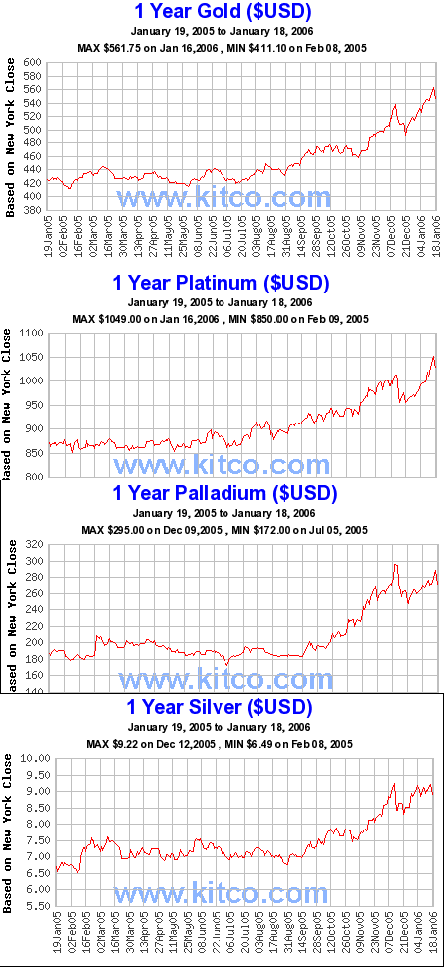
Precious Metal 1-Year Increase:

Image hosted by Photobucket.com

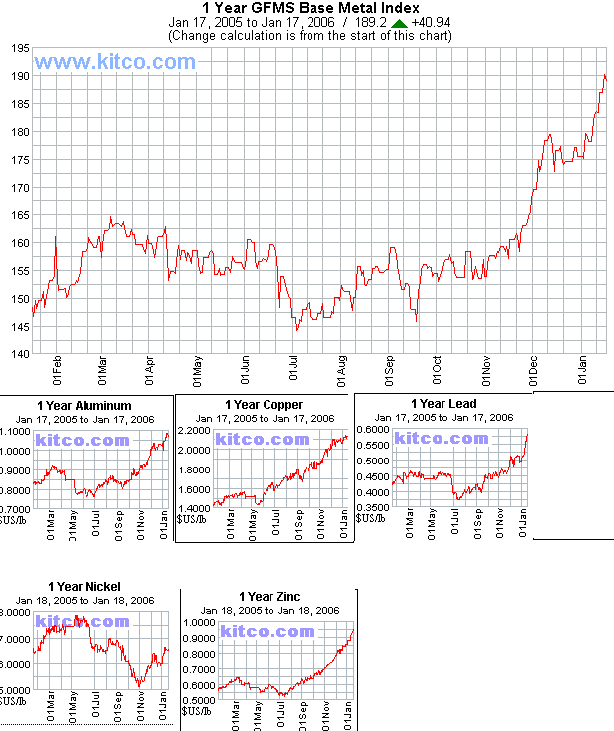
The "GFMS" index is a composite price index of aluminum, copper, lead, nickel, tin and zinc. Below is the GFMS composite, followed by the individual indexes. 4 of the 5 indexes have increased significantly over the last year, in line with the increases noted in gold, silver, platinum, and palladium.

Non-Precious Metal 1-Year Increase:

Image hosted by Photobucket.com


For a more interactive format, see the EconomicPopulistForum

Thursday, August 17, 2006


RECESSION LOOMING?


Retail Sales Decline: Harbinger of Recession?

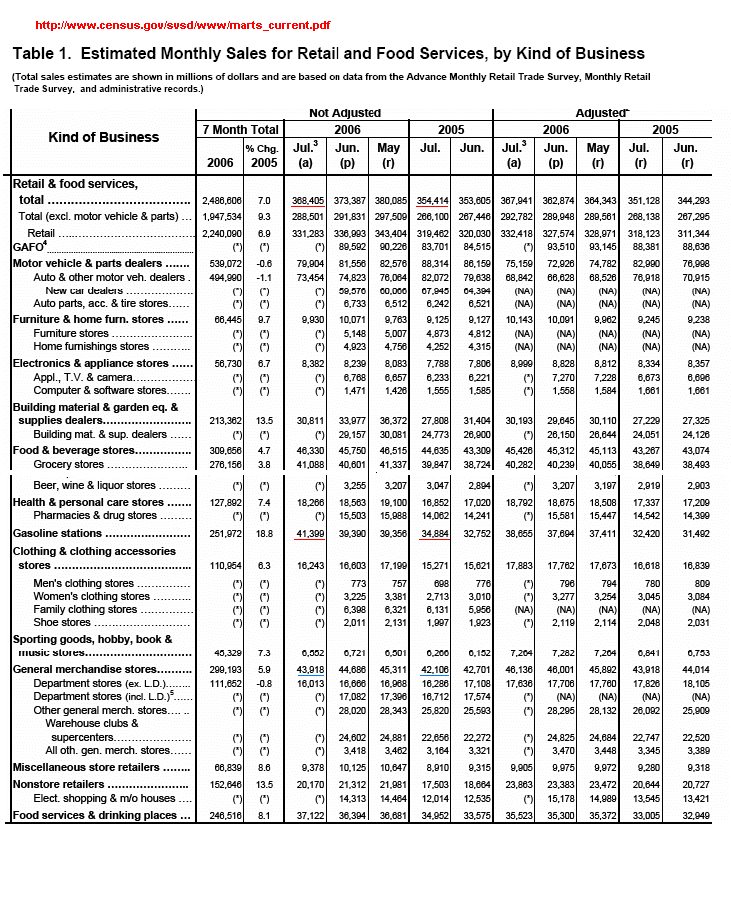
The total nominal increase in July 2006 Retail Sales of $368.405 billion was 3.9% from July 2005's $354.414 billion. However, adjusting for inflation using the Bureau of Labor Statistics Consumer Price Index increase of 4.3%, this reduces the "real" Retail Sales change to -0.4%. However, the figures are even worse if gasoline station sales are subtracted. Subtracting July 2006's $43.918 billion in gasoline sales from the total nominal Retail Sales gives $327 billion. Subtracting July 2005's gasoline station sales from the total nominal Retail Sales (from July 2005) gives $319.53 billion. The difference between the July 2006's retail sales (ex. gasoline station) and July 2005's retail sales is only 2.3% in nominal (non-inflation-adjusted) dollars. Adjusting for inflation using the CPI increase of 4.3% puts the total at a -2.0%. In other words, excluding gasoline station sales, inflation-adjusted Retail Sales declined 2.0% from July of 2005.

This can be seen from the Retail Sales chart copied from the U.S. Bureau of Economic Analysis report on Retail Sales

General Merchandise Sales, which make up the biggest component of Retail Sales, showed a nominal increase in dollar sales of 4.3%. (underlined in blue on the chart above.) Again, this is exactly the same as the increase in the Consumer Price Index of 4.3%. Thus, the real change in General Merchandise Sales since July of 2005 is 0.0%. In other words, there has been NO growth in General Merchandise Sales since July of 2005.


The declining inflation-adjusted Retail Sales numbers are an ominous sign for the economy. They're even more concerning when gasoline station sales figures are not included, which leaves the remaining total for Retail Sales at 2% less than the previous July. Even with increased borrowing, consumers spending is declining. Since consumer spending is 70% of GDP growth, it makes further GDP growth difficult, if not impossible. With consumer borrowing ability expected to fall even further, consumer spending will likely decline further as well. Real wages have continued their steady decline since December 2002. Median real family income has declined every year since 1999. With decreasing consumer spending and decreasing consumer demand, labor demand can be expected to decline even further. The declining labor demand will result in further declines in both wages and employment, reducing consumer spending power even further.

Several noteworthy economists are suggesting a recession is on the way. Paul Krugman has discussed this in his most recent article titled Intimations of Recession. Economist Nouriel Roubini, former member of Clinton's Council of Economic Advisors, has put the likelihood of Recession at 70% by the end of 2006. Another article from the Daily Reckoning has also laid out a strong case for an impending recession. All of these sources have provided a considerable amount of evidence to support their predictions. It appears that our "faith-based" economy is running out of steam. It can no longer be kept afloat by the hot air from the Housing Bubble and the alternate reality creation of the NeoCon-Artist spin machine.


EconomicPopulistForum

Tuesday, August 15, 2006


HOUSING BUBBLE UPDATE: WESTERN U.S.


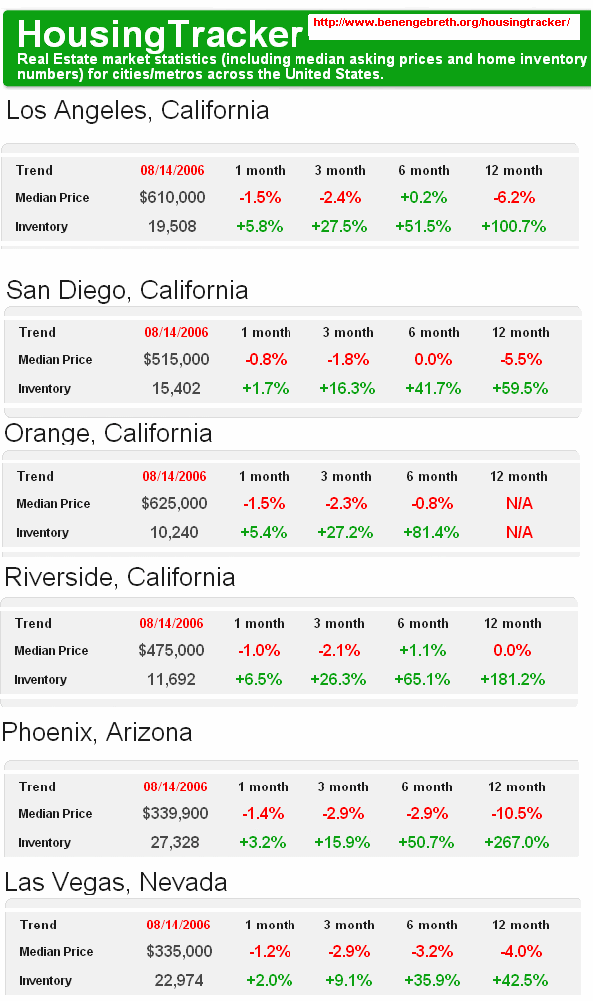
The Housing Bubble is deflating rapidly in most large Western markets. All major markets in Southern California, except for Riverside, have shown significant declines in the last 6 months. (Riverside has had a 0.0% increase in prices over the last 12 months.) Median home prices over the last 12 months have declined 6.2% in Los Angeles County and 5.5% in San Diego County. In Orange County, CA, prices have declined 0.8% over the last 6 months (12-month figures are not available.)

The 2 biggest non-California markets, Phoenix and Las Vegas, have experienced similar declines. Over the last 12 months, Phoenix home prices have declined 10.5% while Las Vegas prices have declined 4.0%. Below is a modified copy of the charts from Housing Tracker.com.


The above information can be found at Housing Tracker

Inventories are rising even faster than prices are dropping. Home inventories have increased 100% in Los Angeles County, 181% in Riverside, California, and a whopping 267% in Phoenix. As inventories continue to rise, prices can be expected to decline even further.


EconomicPopulistForum

Tuesday, August 08, 2006

HOUSING BUBBLE UPDATE, 8/3/06


The Housing Bubble deflation continues to gather speed. Both New and Existing Home Sales are declining. Home mortgage applications are declining. Price appreciation has come to a complete stop. In fact, prices are falling in many places. Inventories of unsold New and Existing homes have increased dramatically over the past year. Residential Construction Investment has declined for 3 straight months. There is little doubt that the Housing Boom has ended. The only questions now are how big the crash will be and how badly it will affect the economy.

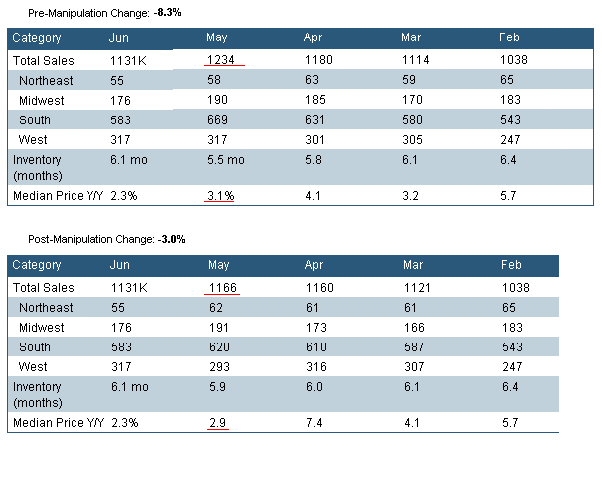
The recent New Home Sales report showed a much larger decline than was anticipated by the so-called "experts." The decline from the original numbers posted from May was actually -8.3%. However, May's numbers were downwardly revised by the government so that the decline in June home sales would not look as bad. Following this manipulation, June New Home Sales were reported as having declined only 3%, not 8.3% (like they actually did.) Below is a link to a copy of the "before" and "after" New Home Sale numbers. The top half of the graphic shows the current New Home Sale numbers superimposed on the previous month's numbers showing what the actual change WOULD have been, had the previous months' numbers not been downwardly revised. The bottom shows the currently "revised" (manipulated) numbers.


The updated version of the New Home Sale decline can be found at Briefing.com at: Briefing.com

According to the U.S. Census Bureau, 103,000 New Homes were sold in June of 2006. This is 12,000 less New Homes sold than the 115,000 sold in June of 2005. This is a decline of 10.4% from the previous June. Meanwhile, the number of New Homes on the market at the end of June was 570,000. This is 112,000 more homes on the market than June 2005's 458,000. This is an increase in the number of homes for sale of 24%. Thus, while the "demand" for New Homes is declining, the "supply" is increasing. As this trend continues, prices will definitely fall even further. This information can be found at the U.S. Census Bureau's New Home Construction.

Existing Home Sales are also declining. June 2006's annualized Existing Home Sales rate of 6,620,000 was 650,000 less than June 2005's rate of 7,270,000 per year. This is nearly a 9% decrease over the last year. The actual number of Existing Homes sold in June 2006 was 700,000, which is 7% less than June 2005's 753,000. The overall price change since June of 2005 was only +0.9%. This is a significant decline in home appreciation from 2005's 9% annual increase, and 2004's 10% increase. Furthermore, were it not for a year-over-year increase in Existing Home Prices in the Northeast, the nation's existing home prices would have declined. Both the Midwest and South areas showed price declines, while the West area had a 0.0% annual increase in price since June 2005. This information can be found at the National Association of Realtors' Existing Home Sales.

In the West, Existing Home Prices have declined -3.4% since their peak $354,000 in November of 2005 to $342,000 at the end of June 2006. Over the last 7 months, Existing Home prices in the West have declined at an annualized rate of -5.8%. In Los Angeles County, median home prices have declined -5.4% in the last 12 months. The decline in prices has been even larger in the homes at the 75th percentile in price, where prices have declined -11% in the last 12 months. This can be seen from the modified graphic below, showing prices from 8/14/05, as well as current prices. (The 12-month change is indicated in blue, with actual numbers horizontally across from the label.


This information can be found in it's original, unmodified form at Housing Tracker


The Pending Home Sales Index of existing homes has declined -9.6% since June 2005. In the West, the Pending Home Sales Index has declined -14.2 % since June of 2005. This information can be found at Realtor.org

Home loan demand has also declined considerably. The Mortgage Bankers Association's seasonally adjusted index of mortgage application activity (which includes both refinancing and home purchasing loans) decreased 1.2% for the week ending July 28. This is its lowest level since May 2002. In the words of economist Drew Matus of Lehman Brothers, "The data suggest that the housing market is cooling and it's cooling pretty substantially." This information can be found in the Yahoo News Story Home Loan Demand Sinks to Four-Year Low.

The Mortgage Bankers Association's seasonally adjusted purchase index declined for the 3rd straight week, dropping 3.3%. This is the lowest it's been since 2003. The purchase index has dropped -24% over the last year, which is consistent with a major decline in the demand for homes.

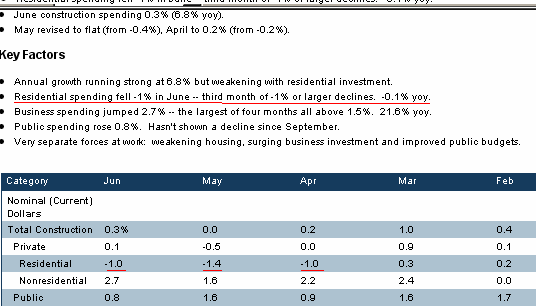
Residential construction spending has also declined 1% or more for 3 straight months. The year-over-year change in residential construction spending is -0.1%. Most likely this is a response to a continual decrease in demand for homes, and an continual increase in the supply of homes for sale. This information can be seen from the graphic below from Briefing.com's "Construction Spending" under the sub-heading "Residential."

Construction Spending


This information can be found at Briefing.com's Construction Spending

All evidence indicates the Housing Bubble is deflating. Even now, annualized numbers give a more benign picture than is actually the case. The deflation of the Housing Bubble has greatly accelerated over the last 7 months, and is anticipated to accelerate even further. This is definitely not a good time to buy a house. The days of home price appreciation have ended, and are being replaced by price depreciation.

EconomicPatriotForum


ILLEGAL IMMIGRATION SUPPRESSES AMERICAN WAGES


The biggest problem created by uncontrolled illegal immigration is wage suppression. According to economics professor George Borjas, immigration reduces the average annual earnings of U.S.-born men by an estimated $1,700, or roughly 4%. (See ABC News article http://abcnews.go.com/Business/wireStory?id=1804778&CMP=OTC-RSSFeeds0312 The actual article by George Borjas can be found at http://ksghome.harvard.edu/~GBorjas/Papers/cis504.pdf ) If that reduction is applied to the roughly 143 million employed Americans, that reduces aggregate annual worker income by $243 billion, or $0.243 trillion. That's roughly 2% of our $12 trillion GDP. That's a loss in consumer spending of $243 billion (less taxes). Given that our entire GDP growth in 2005 was $384 billion, this is a significant amount. Considering that consumer spending is approximately 70% of GDP, that makes the "growth" in consumer spending around $269 billion.

Again, the loss of that $243 billion is no small amount. And it is also $243 billion less money that could have been taxed, costing the Federal government anywhere between $36-61 billion per year. (Increasing the taxable income of a single taxpayer making $42,500/year by $1700 increases Federal income tax by $425. Increasing taxable income of a married taxpayer filing making $42,500/year by $1700 increases Federal income tax by $255. Multiplying these numbers by 143 million amounts to $61 billion and $36 billion, respectively. Thus the income tax revenue lost is somewhere in between.)

Right-wingers will argue that this wage suppression is offset by business profits, and that these profits fuel investment. But investment capital is OVER-abundant at present. Increasing this excess even further will not result in more capital investment. It will result in higher CEO salaries, further overinvestment in the stock market, and further investment in foreign production facilities, the latter of which puts even further downward pressure on American wages.

Furthermore, business profits don't fuel consumer spending. And consumer spending is the engine that drives our economy, not investment. Without consumer spending, there are no returns on investment. And if no returns are anticipated on investment, no investment takes place.

The immigration-fueled reduction in wages does NOT help our economy. It hurts it. It reduces aggregate consumer income and the consumer spending it finances. The reduction in consumer spending reduces consumer production demand, further reducing demand for the labor to provide that production. The reduction in labor demand drives down employment and wages. The resultant labor demand reduction further reduces aggregate consumer income and further reduces consumer purchasing power.

As consumer buying power declines, so do investment opportunities, since those opportunities are created by consumer demand for production. Thus the increased profits resulting from reduction in labor costs create even more excess capital, while reducing investment opportunities still further.

Does anyone really think that wage suppression is "good" for the economy? Doesn't someone have to purchase the goods produced for business to profit? Won't reducing consumer income also reduce consumer goods purchasing? Won't a decline in consumer goods purchasing reduce business revenues and reduce potential profits? Once again, is immigration-fueled reduction in worker/consumer income really "good" for the economy?

----------------------------------

4-30-06

Some are claiming the current GDP report is evidence that "workers" must be doing well, since the economy is doing well. Regardless of the alleged "strength" of the economy, workers' real income continues to decline.

Hourly wages declined 0.24 % in March. Weekly wages declined 0.27%. Below is a copy of hourly and weekly real wages from the U.S. Bureau of Labor Statistics.


Below are links to both weekly and hourly real wages.
BLS-WeeklyWages

BLS-HourlyWages


Below are some recent polls showing the public's sentiment about illegal immigration.


Apparently a lot of people consider illegal immigration a very important issue. And a majority of Democrats want illegal immigration reduced or eliminated.

EconomicPatriotForum

Thursday, July 13, 2006

US-North Korean Free Trade Pact

The Bush dictatorship is apparently working on another "free trade" deal with none other than North Korea. This "deal" was initially described in the Wall Street Journal, and reported by David Sirota at his site. Sirota writes: "The broad strokes are simple: the Bush administration and both parties in Congress are considering signing a "free" trade pact with South Korea that would cover a special project in North Korea that allows Big Money interests to exploit the enslaved people there.

This proposed deal goes beyond the other awful trade deals that we've watched the Bush administration and Congress consider recently - it goes beyond the job-destroying Central American Free Trade Agreement and even beyond the proposed trade pact with Malaysia, a country that prohibits a minimum wage. This trade pact "would be the U.S.'s largest pact since the North American Free Trade Agreement passed Congress more than a decade ago." The Journal story, of course, is filled with hedging. No one wants to come out and say this is what the trade negotiations are all about, or that they really want this North Korea piece - even though its obvious Big Money is salivating for it. What they want is the issue to go back into the background and get quietly passed without anyone noticing. They would rather the public ignore the effort to validate the "joint-venture Kaesong industrial complex in North Korea" that "combines South Korean capital with North Korean labor" (read: combines multinational corporate cash with exploitable slaves). By the time the complex is in full operation in 2012, "it could employ more than 750,000 North Koreans" – again, North Koreans who are literally enslaved and barred from leaving their prison."

"But even beyond the geopolitical implications are the implications for American workers – and workers all over the globe. Even considering this atrocious pact lays bare what our government sees our "free" trade as: a vehicle for driving wages, workplace standards, environmental protections and standards of living into the ground in order to pad Big Money's bottom line. Such a deal would force the world’s workers to compete with slave labor. It would rewarding a dictator like Kim Jong Il in that it would create a premium for corporations to exploit his enslaved population. The fact that this is even being talked about as a legitimate consideration inside our governemnt tells you everything you need to know about the hostile takeover of our government by Big Money interests.
"

Working For Change: U.S.- N. Korea Trade Pact

This is actually hard to believe. But in fact, David Sirota gets this information directly from a Wall Street Journal article. The original article, of course, is chocked full of the spin one would expect from the greed-motivated editors of the Wall Street Journal.

EconomicPatriotForum

Monday, October 31, 2005


WAGE--PRODUCTIVITY GAP

The most damaging factor to our economy today is the Wage-Productivity Gap. This refers to the increase in the hourly production of workers vs. the increase in hourly wages. This concept is described very well in Chapter 6 of economist Ravi Batra's book, "Greenspan's Fraud." During times of true economic prosperity, wages have kept pace with productivity increases. Workers have shared in the benefits of their increased productivity. The result is that wages remained sufficient to purchase our nation's industrial output. Borrowing, or debt-financed consumer spending, was unnecessary to maintain sufficient consumer spending to purchase our production. More production can be purchased because more wages are paid. In general, demand is created by wages, and supply is created by productivity. In a balanced situation, wages match productivity. This causes demand to match supply. This balance makes massive borrowing unnecessary. Such balance maximizes economic "growth."

This balance has not been maintained, however, during recent years. The wage-productivity gap has increased under the Bush administration. Productivity has increased significantly during the Bush years. In contrast, wages have actually decreased. This trend started before Bush took office, but I'll confine the time frame to December 2001 through March of 2005. These are years for which records are readily available from the U.S. Bureau of Labor Statistics. Below is a link to a graph from the New York Times showing how productivity is outpacing wages.
http://graphics8.nytimes.com/images/2005/07/02/business/03cov1.graphic.gif

Image hosted by Photobucket.com

Starting in January of 2003, productivity (or output per hour) has increased 11.2% thru the 1st quarter of 2005. In contrast, real hourly wages declined 2.3% over the same time period, from an inflation-adjusted $8.32/hour in January, 2003, to $8.13/hour in June, 2005. Production has exceeded the ability of wage earners to purchase the production by 13.5%. This gap has been filled by consumer borrowing. ($200-300 billion/year of this "borrowing" has come from home equity loans.) In order to keep pace with increasing industrial production, the amount borrowed must steadily increase. If it doesn't, our economy will sink into recession. However, maintaining demand through borrowing is not a sustainable path.
(Statistics on U.S. Productivity can be found at:
http://data.bls.gov/PDQ/servlet/SurveyOutputServlet?data_tool=latest_numbers&series_id=PRS85006092 )

Sometimes the effect of the wage-productivity gap can be seen better from a distance. An example of this effect can be seen with Japan's economy. Again, this was described by economist Ravi Batra in Chapter 6 of his book, "Greenspan's Fraud." Dr. Batra makes a very compelling case that Japan's economic problems resulted from the increasing gap between Japanese wages and productivity. I will paraphrase his explanation here. Japan experienced extremely rapid growth between 1960 and 1975. During that time there was a 168% increase in per capita GDP. Their per capita GDP increased from $2,139 in 1960 to $5,750 in 1975. Real wages increased 217% during that time. Manufacturing productivity increased 264% during these 15 years. Japan prospered and its economy grew during this period because wages, which create demand, kept up with productivity, which creates supply. There was sufficient WAGE-FINANCED demand to stimulate production. And the necessary demand was maintained by consumer income, not consumer borrowing. After 1975, productivity growth began to outpace wage growth. The result was a much slower growth in GDP. Between 1975 and 1990, productivity increased 3% more than wages per year. During that period, wages increased 27%, while productivity increased 86%. The per capita GDP increase was 64% from 1975 to 1990. Less of the wealth produced by Japanese workers was being shared with them. As a result, business profits soared, increasing money available for investment. This caused Japanese investors to over-invest in both the stock market and housing. Japanese stock markets and real estate values soared as a result of this over-investment. Meanwhile, there was insufficient wage-financed demand to keep up with this capital investment.This necessitated increased levels of borrowing to maintain the demand that wages could not maintain.

By 1990 there was a huge Japanese stock market bubble and real estate bubble. And in 1990 this overvaluation all came crashing down. The Japanese economy has still not recovered 15 years later. By 2003, the Japanese stock market was still 80% below its peak in 1990. From 1990 thru 2002, per capita GDP increased 13%. Compare that with the 168% increase between 1960 and 1975. Compare this latter 15-year increase with the 59% increase during the 27 years from 1975 to 2002. Japan's per capita GDP increased 3 times as much during the 15 years prior to 1975, than it did during the 27 years after 1975. The pre-1975 rate of increase was 5 times faster than the post-1975 increase.

What caused this slowdown? The rise in the wage-productivity gap. Worker income that could have been put to good use buying Japanese goods was siphoned off as corporate profits. Since the benefits of investment capital are limited by consumer demand, the result was over-investment of Japanese stock and housing markets, and maintenance of consumer demand by borrowing.

Does this situation describe any other economy you can think of?

unlawflcombatnt

EconomicPatriotForum

Sunday, October 30, 2005


REPUBLICAN TAX CUTS

Many have asked the question: "Why do Republicans cut taxes without cutting expenses?" This is ab excellent question. Republicans claim it will stimulate economic growth. In fact, it's doing the opposite. Cutting taxes on the top 2% is supposed to increase investment. But there's a catch to this "theory." There needs to be something to invest in. It's only benefit is to increase the SIZE of our industrial capacity. But current industrial capacity is under-utilized. Investment to increase the size of an already underutilized industrial capacity makes no sense. There's simply no current benefit to increasing its size. As such, there is no current benefit to increasing investment.

We need to increase the % UTILIZATION. Investment supposedly increases production. When it does, it does so by increasing industrial capacity size. It has no effect on percent utilization. No amount of investment will increase industrial capacity utilization rates. Only consumer DEMAND increases utilization.

In order for production to increase, there must be an increase in production DEMAND. No amount of investment will increase demand for production. As a result, much of this potential investment capital sits idle. It goes into overvaluation of the stock market, overvaluation of real estate, increased business "cash-on-hand" accounts, foreign bank accounts, CEO bonuses & salaries, stockholder dividends, and last, but not least, Republican campaign contributions.

Meanwhile, the inflationary effect of these tax cuts reduces spendable consumer income, reducing consumer spending. This REDUCES the very "production-demand" necessary to stimulate production, and reduces job growth for workers to provide that production. Thus, the top 2% tax cuts are not only unhelpful, they are detrimental. They slow economic growth. Their inflationary effect reduces inflation-adjusted consumer spending, which reduces the demand for production. Financial analysts have stated on many occaisions that investment capital is plentiful at present. Consumer income is not. Consumer income limits consumer spending, and the production demand it creates. High-end tax cuts are not helpful at present, because increasing potential investment capital is of no benefit. It is NOT growing our economy. It's shrinking it, due to the inflationary reduction of "real" wages caused by these cuts.

It's worth mentioning here that CONSUMER SPENDING is 2/3 of economic activity. It's the largest component of the GDP equation, where GDP=ConsSpen+Invstmt+GovSpen+TradeBal. It makes a lot more sense to try to increase consumer spending at present. It is a larger component than "Investment" capital, and it is in far shorter supply. We need to "change-the-course" back to fact-based economic reality, instead of "faith-based" economic mythology. Investment does NOT create jobs. But demand for production DOES create jobs.

EconomicPatriotForum

Friday, October 28, 2005


OUTSOURCING REDUCES GLOBAL WAGES

Those who advocate pro-free trade often justify their position by stating a desire to uplift the poor in foreign countries. Not only do I oppose that position on nationalistic grounds, I question the benefits to 3rd world countries. Lack of benefit to 3rd-world countries is a point I'd like to make mainly with "liberals."

Outsourcing does NOT raise aggregate global wages. In fact, outsourcing labor to a low-wage country REDUCES global labor wages and income. If a $90/day American laborer is substituted for by $2/day foreign laborer, it reduces aggregate global labor income. Global labor income is what buys production and creates demand. Outsourcing reduces aggregate global labor income, thus reducing total consumer spending world wide. American workers lose income and buying power with outsourcing. That loss is NOT made up for by increase in foreign wages. This is just plain common sense. It's impossible for cost reductions to make up for wage losses.

If American workers can't buy America's production, then foreign workers need to pick up the slack. Does anyone really think that's possible? Can $2/day foreign workers make up for the buying power lost by $90/day American workers? That's $88/day/worker in lost labor income per worker. It would take the labor income of 45 $2/day workers to make up that labor income loss. Does anyone really think that'll happen? Of course not. The only benefit to anyone is the short-term cost reduction to American outsourcers, and a slight price decrease for American consumers. The numbers just don't add up. Global labor competition causes aggregate global labor income to drop. It increases the labor supply available to American corporations, and decreases worker bargaining power. This is simple supply and demand. If the supply of labor increases 100-fold, it will drive the "price" of labor down. Labor "price" reduction means labor wage reduction. Thus, the end result will be a dramatic reduction in American labor income, as well as a lesser reduction in global wages.

Outsourcing and globalization don't "raise" anybody up. They drag all workers down. Jobs will go to the most impoverished workers, and employers won't pay them a penny more than they have to. We cannot enforce minimum wage laws, or other worker protections in foreign countries. Even more important, however, is that Corporate America doesn't want to. Why would they? It would increase the price of their exploited foreign labor. The poorer the worker, the more willingly they accept poverty-level wages. Their impoverishment is Corporate America's gain.

Let's not forget that someone needs to buy the goods produced. Who will buy them if American wages drop to the level of their enslaved foreign counterparts? People can't purchase goods without income. And very low income means very few goods purchased. Demand cannnot be created out of thin air. Consumers must have sufficient income to create that demand. Without demand, there is no need for production, and no need to hire workers.
The entire world economy would collapse without the Demand created by American consumers. That demand is created by American income and borrowing. We're almost maxed out on borrowing at present. In addition, inflation-adjusted American wages are declining. They've declined 1% over the last year, and 0.5% over the last 3 months. The last thing the US and the world need is a further decline in American wages. American wage decline hurts the US, as well as the major exporting countries. If aggregate American labor & consumer income declines, so does our ability to buy foreign imports. Increasing American labor competition with enslaved foreign workers is worsening this wage decline. It's not only in our best interests to keep jobs in the US, it's to the advantage of all countries that export to us. We need income to buy their goods.

"Opening up markets" sounds like a good idea. But it's a smokescreen. It's not the real motivation behind "free" trade agreements. The real motivation is "opening up" the American labor market to competion with slave-labor. Bush and his neocon supporters know this. They hope we won't see it. Many of us do, however. Hopefully we can make others see this as well.

unlawflcombatnt

EconomicPatriotForum

Wednesday, October 12, 2005


GDP overstates ECONOMIC GROWTH

Again, it appears that the calculated GDP has overstated actual economic growth. June 29th's published GDP figure of 3.8%, is the same as the last quarter of 2004. However, growth of the 2/3's of economic activity due to consumer spending is slowing. The "final sales" growth, which many consider a better indicator of "growth," has declined for the 2nd straight quarter. In addition, growth of most "investment" parameters are also slowing.
The link to these numbers can be found at Briefing.com's GDP section at:
http://www.briefing.com/Silver/Calendars/EconomicReleases/gdp.htm

The 1st quarter GDP has now been revised upward to 3.8%. Again, this is the same as the 4th quarter of 2004. However, of the multiple factors used to compute this number, only 2 have increased significantly. The 1st of these is INVENTORIES, which increased from $47.2 billion in the 4th quarter of 2004 to $66.8 billion in the 1st quarter in 2005. This is a 42% increase over the previous quarter. The 2nd major increase was in "residential investment." (Housing & Real Estate) Here there was a 338% growth in the 1st quarter of 2005, from 3.4% in Q4, 2004 to 11.5% for Q1 of 2005.

In contrast to the above "increases," GDP final sales growth declined for the 2nd straight quarter. GDP final sales growth decreased to 3.0% from the 4th quarter's 3.4%. This marks a 13% DECREASE. The 4th quarter's GDP final sales also represented a decrease from the 3rd quarter's 5.0%. Thus, GDP final sales are not keeping up with the measured GDP. Ultimately, the GDP must be sold to create profits. The declining GDP "final sales" growth, in relation to the the total GDP, suggests the GDP is overestimating economic growth.

All other measures of consumer spending declined as well. Total personal consumption spending (PCE) growth decreased to 3.6% from the 4th quarter's 4.2%. All 3 components of PCE declined as well. Durable goods sales growth decreased 54%, declining from 3.9% in the 4th quarter to 1.9% for Q1 of 2005. Nondurable goods and services also decreased.

Nonresidential investment growth also decreased 72%, from 14.5% in Q4 of 2004, to 4.1% in the 1st quarter of 2005. Not only did growth in nonresidential investment not increase, it actually decreased in Q1 of 2005. The growth rate was actually -2.4%. Growth in equipment and software investment decreased from 18.4% in Q4, to 6.1% in Q1 of 2005.

Thus, GDP growth was maintained almost exclusively from increased real estate investment and increased unsold inventories. All indexes of consumer spending growth decreased. This comes as no surprise, considering inflation-adjusted wages also decreased during that time. Decreased consumer spending power usually decreases consumer spending.

It appears the calculated GDP has again overstated actual economic growth. Goods are being produced in excess of what consumers are purchasing. Excessive goods production drives down demand for labor to produce goods. This decreases the number of employed workers, as well as wages of those who are still employed. This results in a further decrease in the aggregate consumer income necessary to purchase goods.

Growth of inventories and real estate investment are all that have increased during the 1st quarter of 2005. Does this really represent economic "growth"? Doesn't declining growth in consumer spending imply an economic slowdown? Do isolated increases in unsold goods and real estate investment truly indicate economic growth? Can unsold goods and real estate investment really be substituted for consumer spending? Can profits lost from declining goods sales be replaced by production and investment increases? How does that increase profits? Doesn't someone have to buy products for profits to be made?

Update: 11/27/05
It now appears that the 3rd quarter 2004 GDP has been revised downward to 3.6 % which is what it was initially reported as like it in January of 2005. (By June 2005 it had been upwardly, and incorrectly, revised to 3.8%. Apparently they just "honestly" overestimated in June.)

Below are the graphs of the GDP previously reported, which were posted by "Briefing.com." The 1st is from January 2005, the 2nd is from June 2005, and the 3rd is from 11-27-05. Again, not the difference in the 4th quarter 2004 GDP. It has been revised back down to the previously reported 3.6% number.


1-28-05
Image Hosted at ImageHosting.us


6-29-05


11-27-05


Also of interest is that the 4th quarter GDP from 2003 has also been downwardly revised. Up through June of 2005, it had been listed as being over 4%. Now it has also been revised downward to 3.8%.

It's simply amazing how the Bush propagandists continue claiming a GDP growth rate of 4%. There hasn't been a quarterly GDP growth rate of 4% since the 3rd quarter of 2004, and only 2 since the 3rd quarter of 2003. Yet again the Bush-ites maintain that the economy is "strong, and getting stronger," with a GDP growth rate of "around 4%." We truly have a "faith-based" economy that depends on distortions and "faith" , not "facts."

EconomicPatriotForum

Friday, September 02, 2005

ECONOMIC GROWTH and WEALTH DISTRIBUTION


The benefits of hard work are often stressed in our society. Most agree that hard work and productivity should be rewarded. Those that are more successful usually receive larger rewards than those who are less successful. Successful businesses rightfully expect to be compensated for their success.


At some point, however, these rewards may become excessive, as well as counterproductive. If businesses are rewarded excessively, at the expense of labor & consumers, it will decrease their own ability to sell their products. If workers aren't compensated well enough, their ability to buy production is reduced. This reduces business profits, and reduces economic growth.


LABOR, along with the production tools built by CAPITAL, are the factors that produce wealth. The combination of labor and capital combines to increase the value of raw materials. They do this by creating something more valuable than the original raw materials. You might call this a "labor value-added" effect, or a "capital-labor value added" effect. Though LABOR is absolutely essential, it's wealth-producing capacity is severly reduced without sufficient CAPITAL investment, because of the production enhancers capital provides. But capital, without labor, has NO value. Furthermore, without demand for production, neither capital or labor will be used to create wealth. Capital won't be invested, if there's no potential profit. Workers won't be hired, if the product of their labor cannot be sold. Low consumer income, with low consumer spending, reduces the ability of capital to create profits. It reduces the ability to SELL finished products. Profits are made by SALE of goods, not production of goods. As such, low consumer income not only hurts consumers, it hurts the businesses who sell to consumers. INCREASING CONSUMER INCOME HELPS BUSINESS, as well as consumers.


The major functions of capital are to provide raw materials and to increase industrial CAPACITY. This increases potential ability to produce goods and create wealth. But there's a catch here. The actual production of goods and wealth requires UTILIZATION of this industrial capacity. No wealth is produced by industrial capacity that remains idle. And there is no benefit to increasing industrial capacity size when it is currently under-utilized. In the case of under-utilization, wealth will only be created by increasing current utilization RATE. Economists refer to this as CAPACITY UTILIZATION RATE (or industrial capacity utilization rate.)


Our current industrial capacity is UNDER-utilized. The utilization rate has dropped from 85% during the Clinton years to 79% at present. Increased investment to increase the size of this capacity is not beneficial. In contrast, increasing the utilization RATE would be very beneficial. What would increase the rate? You guessed it. Increased DEMAND for production. Demand that would rise from increased consumer spending, resulting from increased consumer income. I can state this concept in 2 equations: Reduced Capacity Utilization = Reduced Consumer DEMAND. Increased Capacity Utilization = Increased Consumer DEMAND


For maximum economic growth, there needs to be a balance between the "means of production" and the "means of consumption." (This equates to Supply equaling Demand) Shifting the balance in either direction reduces economic growth, wealth production, and GDP. Excess production, when measured in terms of potential dollar-value, cannot be sold. As such, no profits can be made from it. In contrast, insufficient production in terms of quantity can be profitable. Prices can be raised to maximize profit from that limited production. Raising prices reduces the quantity demanded. This allows the supply to meet the demand. The reverse is only true in terms of quantity demand. Demand can be increased by reducing price, but the dollar-value of that demand does NOT change. The dollar-value of demand is limited by spendable consumer wealth. This is where the concepts of Micro Economics end, and Macro Economics take over. This is where AGGREGATE DEMAND comes into play.


Aggregate demand is absolutely limited by aggregate consumer wealth. The best way to increase aggregate consumer wealth is to balance the "means of production" with the "means of consumption." The capital invested needs to be no greater than that needed to meet production demand. In turn, production demand is created by the "means of consumption." If resources are un-balanced in favor of the "means of production," there will be insufficient demand to drive production. As a result, there will be less production, and less wealth produced. In contrast, greater wealth would have been produced if some of the investment capital had been re-directed towards consumer income. It would have increased demand, and driven production. Both consumers and business would have prospered. Economic "growth" would have increased. GDP would have increased.


If investment and consumer income are out of balance, correcting the imbalance increases economic growth, and improves our economy. If investment capital is excessive, diverting that excess into consumer income increases the benefit of the remaining capital. Taxing the affluent more to improve this balance is not "socialistic." It's "capitalistic." Balancing the "means of production" with the "means of consumption" is not a "share-the-wealth" concept. It's an "increase-the-wealth" concept. Such "wealth redistribution" would increase "wealth production." It would increase industrial production and GDP. Again, insufficient consumer spending REDUCES GDP. It reduces wealth creation by labor and capital, by reducing the demand for its creation.

Demand may not be everything. However, it is the biggest single factor affecting our economy. Consumer spending is the "dollar-value" measure of that demand. The consensus among economists is that 2/3 of economic activity is consumer spending. From this one would conclude that the most important factor in economic growth is consumer spending, or the "dollar-value" of consumer demand. Again, it's not the only factor, but it's the biggest factor.


I think the significance of DEMAND is under-emphasized in current economic commentary. That needs to change. This is not only about the subjective concept of "economic justice". It's also about "economic growth." It's my belief that some downward redistribution of wealth will help the economy. It will increase wealth production, because it will help balance the "means of production" with the "means of consumption." We would ALL benefit from a better balance of these factors, rich and poor alike.


The Bush Administration has done its level best to keep investment and consumption out of balance, thus TEMPORARILY allowing business to profit excessively from labor, despite the long term cost to ALL AMERICANS. Bush policies hurt ALL Americans in the long run. The following is a link to a graph from "Briefing.com." It shows the relative levels of personal consumption expenditures and investment capital. See which way you think the "balance" is shifted at present.


This chart can also be found at Briefing.com at
http://www.briefing.com/Common/Images/Content/PageContent/EcData/pce.gif


EconomicPatriotForum

Friday, August 05, 2005


THE MIS- INTERPRETATION OF KEYNES

Keynesian economics has been criticized for its advocacy of government spending to prop up AGGREGATE DEMAND. But it is a mistake to define Keynesian economic theory simply as advocacy of increased government spending. This was a very limited part of his theory.
Keynes' greatest contribution to economic thinking was his recognition of the importance of AGGREGATE DEMAND. Keynes correctly identified aggregate demand as THE most important factor in economic activity. Keynes explained why aggregate demand was the major driving force of an economy. With no aggregate demand, there is no production or industrial output. Low aggregate demand results in low production and industrial output.

Keynes advocated increasing aggregate demand through increased government spending if it was insufficient to drive industrial output. This could be done through government deficit spending. This was NEVER intended to be anything but a short-term fix. This temporary fix was designed to put labor back to work, thus increasing labor/consumer income, as well as the increased consumer demand that would follow. The desired end result was to put labor and production facilities back to work, returning them to their wealth-creating function.
No production or wealth is created when workers and production facilities sit idle. By temporarily increasing aggregate demand, those facilities would be restored to their wealth-creating function. With the newly increased aggregate labor/consumer income, and the increased consumer demand that resulted, a self-perpetuating cycle would be initiated. The increase in consumer income and production demand would cause FURTHER increases in demand for workers to provide that production. As a result, more workers would be hired and aggregate labor/consumer income would increase still further. Again, this would further increase consumer spending and demand, causing even further hiring of workers to provide the increased demand. Though not specifically stated by Keynes, but of equal importance, the ever increasing demand for labor would increase wages as well. This would even further increase the AGGREGATE DEMAND that Keynes was trying to prop up.

Keynesian government "pump-priming" efforts were less successful initially than would have been predicted. There were 2 general reasons for this. The 1st related to the magnitude of "pump-priming" necessary. The other related to consumer behavior.

The biggest reason for the suboptimal result of Keynesian aggregate demand infusion was that it was not large enough. The pre-World War II government spending increases that Roosevelt put in place were simply not enough to adequately jump-start the economy. Inadvertently, it was the much larger increase in government spending caused by World War II that successfully jump-started the economy. The massive government spending that entailed increased AGGREGATE DEMAND enough to get the economy rolling again, and end the Great Depression. Keynes was proven right about the necessity of aggregate demand, and that increasing it would restore the economy to normal. But no one knew how much was necessary until the onset of World War II.

The 2nd reason Keynes' ideas were not initially successful was due to consumer behavior. The limited increases aggregate consumer income did not have the magnitude of effect on consumer spending that was anticipated. After years of low income and poverty, Americans were less likely to spend their increased income than they would have been today. They held on to much of their increased income, instead of spending it. Consumers were uncertain as to what the future might bring. The less than predicted consumer spending caused a less than predicted increase in consumer production demand, and aggregate demand as a whole. The suboptimal production demand increase caused a suboptimal demand for labor to provide that production.

The Depression had caused consumers to semi-permanently lower their spending habits. Again, the result was consumer spending & demand lagged behind consumer income. One might say there was a pronounced lack of "consumer confidence." This understandable lack of confidence fed back on itself, however, causing aggregate demand to be insufficient to resurrect the economy. Again, it took the massive increase in production demand, employment, and consumer income caused by World War II to break the cycle.

Keynes never envisioned increased government spending as a PERMANENT solution to an aggregate demand deficiency. It was to be a TEMPORARY solution only. Once the economy was doing well the debt was to be paid down. The fact that it wasn't has nothing to do with Keynes, or his theories.

Many who discredit Keynes are fully aware of this point, but claim otherwise. They attempt to dismiss Keynes as simply an advocate of "big government." Again, his critics are being dishonest with this claim. Their true dislike of Keynes has nothing to do with Keynes' alleged advocacy of big government or government spending.

The REAL motivation is Keynes' recognition of the importance of AGGREGATE DEMAND. Acknowledgment of this importance discredits many popular, yet illogical, economic beliefs. It refutes the completely illogical notion that "investment creates jobs." It refutes many tenants of classical economics, as well as monetarism and supply-side theories.

In general, acknowledgment of AGGREGATE DEMAND's significance refutes the beliefs that "trickle-down" economics, or "priming the pump" from the top, is of any benefit. In a more practical sense, it refutes the benefits of high-end tax cuts, corporate tax cuts, and labor cost reduction through outsourcing. In fact, Keynes showed that anything that was bad for the consumer was bad for business, as well as labor and the overall economy in the long run. Keynes demonstrated that reduced aggregate demand would hurt the economy, regardless of how much investment capital was available. He showed clearly that it is DEMAND that creates jobs, not investment. The Great Depression proved him right.

EconomicPatriotForum